Executive Summary
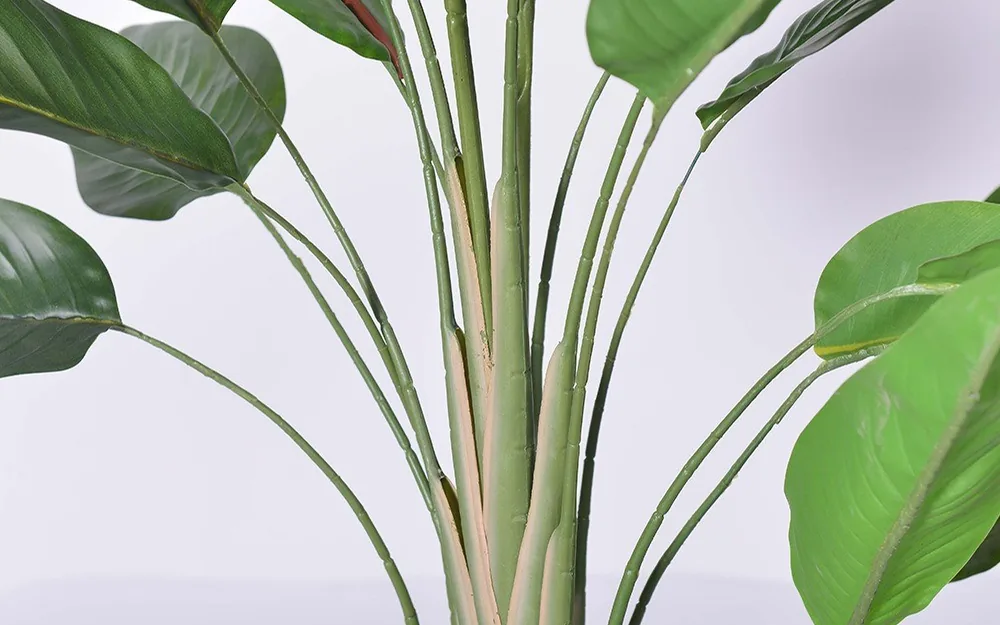
A 150–180 cm potted bird of paradise arrives in one carton of 0.14–0.18 m³ at 9–14 kg, with two or three stems packed separately and a pre-fitted socket in the pot. Assembly takes 6–10 minutes without tools. No water, no light requirement, no repotting. Delivered to the door, it holds its colour for years in a room where a real one dies in six weeks.
1. What Goes Wrong Without This
The failure is usually not the plant. It is the match between the plant, the room and the delivery, and each mismatch has a predictable cost.
A real plant in the wrong room. A bird of paradise needs 6–8 hours of bright indirect light and a pot that drains. In a north-facing villa corridor or an apartment corner 3 m from a window, the leaves curl within three weeks, the stems lean, and the plant is replaced two or three times a year at AED 350–700 a time — plus the watering, the fungus gnats and the soil that ends up on the floor. Over five years that habit costs more than a specimen that never changes.
The 90 cm piece in a 5 m room. Height reads relative to the space. In a room with a 3.2 m ceiling, a 90 cm plant disappears against the wall and looks like a hotel lobby prop; the same room needs 150–180 cm to register from the doorway. In a 2.6 m apartment with a low sofa, 120 cm is the ceiling before the plant starts to dominate the seating.
A pot that tips. A 180 cm specimen with a 2.4 kg pot tips at a 12–15° nudge, which is what a child, a dog or a vacuum cleaner delivers. The pot, not the foliage, decides stability: a 150 cm piece needs 6–9 kg of pot and ballast, a 180 cm piece 10–14 kg, and a pot filled with foam instead of sand is the single most common reason a floor plant ends up on its side.
Smell in a closed room. Inexpensive foliage with a plasticizer-heavy mix gives off a noticeable odour for the first two to six weeks, and in a bedroom with the AC running and the door closed, that odour stays. Phthalate-free polymers and a low-VOC finish are what remove it, and they are worth asking about before the piece enters a bedroom rather than after.
Assembly that arrives as a puzzle. Stems shipped loose with no socket marking turn a ten-minute job into an hour, and a stem pushed in at the wrong angle sits visibly crooked for the life of the plant. Numbered stems, a marked socket and a two-page card fix this; a bag of loose parts does not.
Delivery to the kerb. A villa gate, a lift lobby and a 1.9 m carton are three separate constraints. Kerb-side delivery leaves the owner carrying 14 kg through a garden; a carton that does not fit the lift ends up opened in the lobby. Door delivery has to be specified as door delivery, with the carton dimensions stated.
Direct sun and the AC vent. Even an artificial piece has placement rules. Six hours of direct sun through a west window fades a low-grade print within two seasons, and a position directly under an AC vent coats the leaves with dust in a month. Both are avoidable at the layout stage.
2. The Decision Framework
Six questions settle the purchase, and all six can be answered with a tape measure and a phone.
1. What height does the room need? Measure the ceiling and the wall the plant will stand against. The working ratio is 0.5–0.6 of ceiling height for a floor specimen: 2.6 m ceiling → 130–155 cm, 3.2 m → 160–190 cm, 4 m and above → 200–240 cm. A plant below 0.45 of the ceiling reads as furniture; above 0.7 it crowds the room.
2. How wide is the corner? A 180 cm bird of paradise spreads 80–110 cm at the crown. In a 90 cm alcove the leaves press against both walls and the shape is lost. Leave 15 cm of air on each side, or choose 150 cm.
3. What pot, and how heavy? For a floor piece, the pot should be 30–40% of the plant height in diameter and heavy enough that the centre of gravity sits low: 6–9 kg for 150 cm, 10–14 kg for 180 cm, including the ballast. Ceramic and concrete are stable; thin plastic needs a sand-filled insert, not foam.
4. Who lives in the room? With toddlers, cats or dogs, three details matter: no exposed wire stem ends at the base, phthalate-free foliage, and a pot heavy enough not to topple. Foliage that sheds printed flakes is a sign of a cheap surface finish and should be rejected on inspection.
5. How many pieces arrive, and how long does assembly take? Ask for the stem count and the assembly time in writing. A 150 cm piece is typically three stems and 6–8 minutes; a 180 cm piece four stems and 8–10 minutes. Anything quoted at "some assembly required" without a number is a cost waiting to happen.
6. What does delivery actually include? Door delivery, unpacking, assembly and packaging removal are four separate services. For a villa, confirm the gate width and whether the courier will carry the carton to the room; for an apartment, confirm the lift dimensions against the carton length before the order is placed.
Two of the six carry most of the weight. The height ratio decides whether the piece looks right in the room, and the pot weight decides whether it stays upright for five years. Both are decided before the order, and neither can be fixed afterwards without buying again.
3. Numbers, Tiers and Timelines
The table covers the five sizes that account for most residential orders. Carton figures are for a single potted piece with stems packed alongside; delivery days are door to door for a GCC city address.
| Height (cm) | Stems / leaves | Pot Ø (cm) | Carton (m³) | Packed weight (kg) | Assembly time | Door delivery |
|---|---|---|---|---|---|---|
| 90 | 2 stems / 7–9 leaves | 22–25 | 0.05–0.07 | 3.5–5 | 4–6 min | 3–5 days |
| 120 | 3 stems / 10–12 leaves | 26–30 | 0.09–0.12 | 6–8 | 6–8 min | 3–5 days |
| 150 | 3 stems / 12–15 leaves | 30–34 | 0.13–0.16 | 9–12 | 6–8 min | 5–8 days |
| 180 | 4 stems / 15–18 leaves | 34–40 | 0.17–0.22 | 12–16 | 8–10 min | 5–8 days |
| 210 | 4–5 stems / 18–22 leaves | 38–45 | 0.24–0.30 | 16–21 | 10–14 min | 7–10 days |
Three practical readings from the table. First, the 150–180 cm band covers most villa living rooms and is the size where the pot weight starts to matter; below 120 cm the piece is a shelf plant and the pot is not a stability question. Second, carton volume roughly doubles between 120 cm and 180 cm, which is why the 180 cm piece is usually shipped on its own pallet position rather than consolidated with small items. Third, delivery times are not the constraint — assembly and placement are, and a two-day delivery that lands before the room is painted is worse than a five-day delivery that lands after.
Care changes the ownership experience less than people expect. A dusting every 8–12 weeks with a dry microfibre cloth, a wipe of the pot rim, and a check that the stems are still seated takes about 15 minutes a year. There is no watering schedule, no fertiliser, no repotting, and no seasonal leaf drop. For a household that travels, that is the whole argument: the plant does not notice absence.
Where a room calls for a height outside the standard range, the pot, stem length and leaf spread can be built to the ceiling line rather than the catalogue — a 240 cm corner with a 4.2 m ceiling is a specification, not a special favour. The same applies to pot finish: matte ceramic, ribbed concrete and woven baskets all read differently against a wall, and the finish is worth matching to the floor before the piece is ordered rather than after.
4. How to Apply It to a Live Project
Stage 1 — Measure the room, not the plant. Note ceiling height, the wall length of the intended corner, the nearest window direction, and any AC vent within 1.5 m. A photograph taken from the doorway at eye level is more useful than a dimension sketch, because it shows how the corner reads in the room.
Stage 2 — Choose size and pot together. Set the height from the ceiling ratio, then pick the pot diameter at 30–40% of that height. Order the pot finish against a floor sample or a photograph in daylight; a pot that matches the floor visually disappears, which is usually the intent in a small room.
Stage 3 — Confirm delivery route before ordering. Measure the villa gate, the lift door and the lift cabin, and compare against the carton length. A 180 cm piece ships in a carton around 190 cm long; a 1.2 m lift door is fine, a 0.9 m stair turn is not. This is the step that turns a delivery into an argument.
Stage 4 — Receive, unpack, assemble. Check the carton for compression damage before signing, then unpack in the room where the plant will stand. Seat the stems into the marked sockets, working from the tallest to the shortest, and check the crown from three metres away — that is the distance every guest will see it from.
Stage 5 — Place with the two rules. Keep 1–1.5 m from a west-facing window that takes direct afternoon sun, and at least 1 m from an AC vent outlet. Both protect the surface finish and both are easier to honour at layout than after the furniture arrives.
Stage 6 — Set a cleaning rhythm. A dry dust every 8–12 weeks, a damp cloth on the pot rim, and a visual check that no stem has worked loose. Put it in the household calendar next to the AC filter change; the two tasks take the same afternoon and both get forgotten otherwise.
For households furnishing several rooms at once — living room, majlis, entrance hall — ordering the pieces as one delivery keeps the leaf colour consistent across rooms. Two orders placed a season apart can differ by 2–4 ΔE, which is invisible on one plant and obvious when a 150 cm and a 180 cm stand in the same sightline. The potted plant range is the place to check which heights share a mould and therefore a colour batch.
5. Commercial Contractor FAQs
Q: Does a maintenance-free potted bird of paradise need any light at all?
No. It needs no light to survive, which is why it works in corridors, interior bathrooms and north-facing rooms. Direct afternoon sun is the one thing to avoid, because UV fades a low-grade print over two or three seasons; a position 1–1.5 m back from a west window is enough.
Q: How stable is a 180 cm piece around children and pets?
With a 12–16 kg packed weight and a 34–40 cm pot, it takes a firm push rather than a brush to move it. Where the household has toddlers, add a 2–3 kg sand bag inside the pot base; that lowers the centre of gravity more than adding height to the pot.
Q: Can the plant be shortened if the ceiling turns out lower than expected?
On most builds the stems seat into a socket and can be swapped for shorter ones, but the leaf spread stays the same. It is cheaper to measure the ceiling first than to rebuild afterwards; where the ceiling is unusual, order to the measured height rather than the nearest catalogue size.
Q: Is it safe in a bedroom with the AC running all night?
With phthalate-free foliage and a low-VOC finish, yes. Ask for the material declaration before the order if the piece is going into a small bedroom, and air the room for a day after unpacking — the carton, not the plant, is usually what smells at first.
Project Engineering Support & CAD Requests
We ship residential pieces as single-carton door deliveries with numbered stems, a marked socket and a one-page assembly card, and we build heights to the measured ceiling rather than the nearest catalogue size. If a room has an awkward corner, send a photograph from the doorway with the ceiling height and the wall length, and we will return two size options with the pot diameters drawn against the space. Custom heights and finishes are quoted through the custom solutions route, and the standard potted sizes are listed on the product pages.
👉 Chat with Structural Engineering on WhatsApp (Instant Project Review)