Large faux olive trees specified for commercial atriums must incorporate a Q235 hot-dip galvanized steel core sized Ø48–76 mm against a 3–8 m height range, inherently flame-retardant (IFR) polyethylene foliage certified to NFPA 701 as standard (EN 13501-1 B1-s1,d0 available for GCC and EU tenders), and a ballast or slab-anchored base rated for 180–320 kg live load. Canopy density runs 1,800–3,200 leaves/m³.
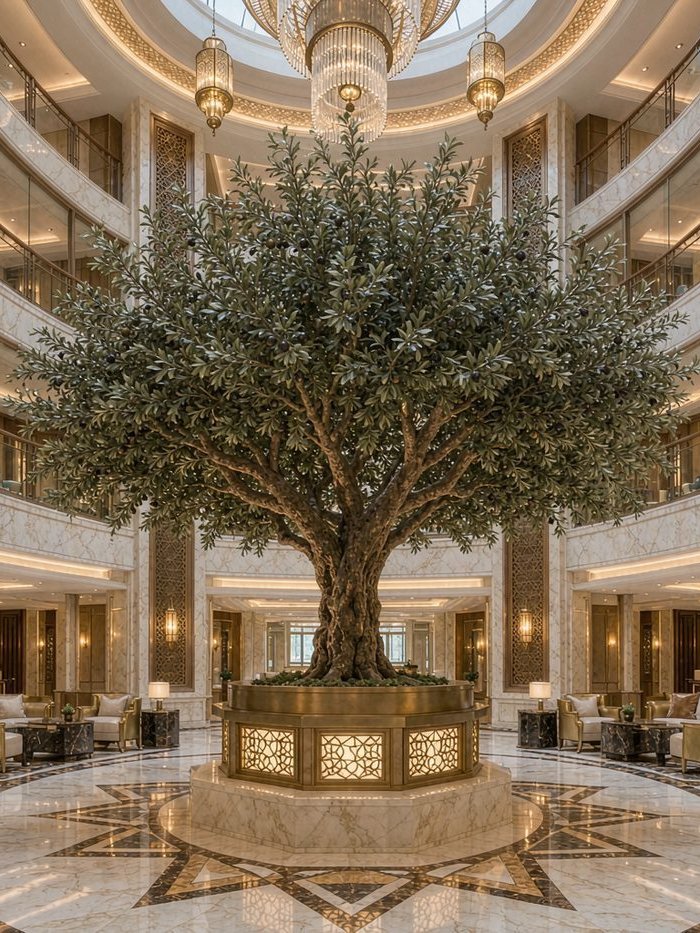 Large faux olive tree (4–6 m) anchoring a commercial atrium, demonstrating finished spatial scale against a double-height lobby.
1. Failure Modes & Commercial Pitfalls
Most atrium tree failures are specified, not manufactured. Three patterns recur in hospitality and retail fit-outs.
Silk foliage under 24/7 atrium lighting chalks and yellows within 8–12 months, and its woven surface traps dust that cannot be wiped without shredding the leaf. A lobby feature that looks tired in under a year is a recurring capital expense, not a one-time install.
Foam or timber trunk cores develop canopy sag — structural creep — as the armature relaxes under its own weight and HVAC airflow vibration. In a 6 m specimen this shows as visible droop at the branch tips within 18 months, and a timber core in a humid atrium becomes a pest and moisture pathway the facilities team never planned for.
Surface-spray fire retardant is the silent failure. The coating degrades with handling and skylight UV; once worn, the foliage no longer meets the submitted fire class, and the fire marshal rejects the submittal at fit-out — after procurement is closed.
Finally, under-ballasted planters tip. A 6 m tree in a high-traffic lobby with constant air movement needs a computed ballast, not a decorative pot filled with sand.
2. Material Science & Structural Engineering Standards
Internal structural core. Commercial-grade atrium trees use Q235 hot-dip galvanized steel tubing, wall thickness 3–5 mm, with continuous fillet welds at branch joints (AWS D1.1-class shop welds). Core diameter scales with height: Ø48 mm at 3 m, Ø60 mm at 4–6 m, Ø76 mm above 6 m. This sizing eliminates long-term canopy deflection; foam or timber cannot hold the same stiffness-to-weight at 6 m without external bracing.
Bark and surface finishing. Centrifugal fiberglass casts taken from a natural olive trunk carry real grain and fissure geometry. Synthetic foam "bark" skins photograph flat and crack at the trunk bend under load. The fiberglass jacket is bonded to the steel core, so the texture is structural, not cosmetic.
 Factory welding of the galvanized steel armature and trunk core; the fiberglass bark jacket is bonded to the core.
Foliage engineering. Injection-molded polyethylene (PE) leaves hold colour under constant atrium lighting far longer than silk and shed dust with a simple wipe. Specified leaf density is 1,800 leaves/m³ at 3–4 m, 2,600 at 4–6 m, and 3,200 at 6–8 m — the metric that drives visual fullness and shadow casting in a double-height space.
3. Life Safety, Fire Codes & Environmental Compliance
North America. Atrium installations are typically evaluated to NFPA 701. Method 1 applies to single-layer textiles and small specimens; Method 2 covers larger assemblies. Specify which method the submitted certificate reports — a Method 1 pass on loose foliage does not cover the assembled canopy.
Europe and GCC tenders. EN 13501-1 Class B1-s1,d0 is the common requirement for public-commercial interiors. IFR (inherently flame-retardant) polymer meets this as a material property; surface-sprayed treatments do not hold the class after wear.
Indoor air quality. Sealed HVAC atriums recirculate air through occupied volumes, so the foliage polymer should be low-VOC and odorless. PE used in commercial canopy systems carries no off-gassing signature and passes low-VOC specification for enclosed environments.
4. Technical Comparison Table
| Tree Height (m) | Min Core Steel Ø (mm) | Leaf Density (leaves/m³) | Floor Live Load & Ballast (kg) | Application | Indoor/Outdoor |
|---|---|---|---|---|---|
| 3–4 | 48 | 1,800 | 180 | Hotel lobby accent, reception | Indoor |
| 4–6 | 60 | 2,600 | 240 | Hotel atrium, mall atrium | Indoor |
| 6–8 | 76 | 3,200 | 320 | Double-height atrium feature | Indoor |
All versions: IFR PE foliage (NFPA 701 std / EN 13501 B1 on request), zero maintenance, odorless. Heights above 6 m require the anchoring detail in §5.
5. Structural Anchoring & MEP Coordination
Two mounting systems. Below 5 m, a ballast collar inside a decorative planter — a 600 × 600 × 12 mm steel base plate with four M12 bolts to the slab, centre of gravity kept low — holds the specimen against lobby HVAC air movement. Above 6 m, or wherever the planter is shallow, the trunk flange bolts directly to the structural slab or a built-out column (M16–M20, four points), with the connection hidden below the finished floor.
MEP coordination is where atrium schedules slip. The tree crown must clear sprinkler throw (NFPA 13 spacing still applies to the volume it occupies), and a high-velocity air curtain at the entrance drives steady lateral load on a 6–8 m canopy that the ballast must resist. The anchor passes through the same fire-rated floor the sprinklers protect, so the anchor drawing and the fire-submittal package should move together — discovering the conflict at fit-out means rework.

6. Commercial Contractor FAQs
Q: Will the tree trigger the atrium smoke detector or fire alarm? A: No. IFR-treated PE foliage does not smoulder under normal atrium conditions, and there is no irrigation or electrical load inside the tree. The treatment certificate ships with the submittal so the fire consultant can file it.
Q: What is the lead time from order to atrium? A: Standard heights ship in 25–35 days. Custom bark texture or a specific canopy spread adds lead time, quoted before the PO is signed rather than after.
Q: Can the olive variety be matched to a brand's Mediterranean theme? A: Yes. Leaf colour (silver-green to deeper green), trunk taper, and canopy density are adjusted per the mood board; most adjustments are free within the standard height range.
Q: Can the tree sit under an active sprinkler zone? A: Yes, provided crown clearance to sprinkler heads meets the project's NFPA 13 spacing. Flag this on the anchor drawing so the fire engineer coordinates it early.
Project Engineering Support & CAD Requests
Our manufacturing team delivers against these architectural specs with full submittal packages: stamped shop drawings, the fire-certificate pack (NFPA 701 and EN 13501 on request), and physical finish sample swatches for bark texture and leaf colour sign-off before production. For atrium or lobby specification, send the clear height, the planter dimensions, and the venue fire standard (NFPA 701 or EN 13501). We return a structural sketch, a ballast calculation, and a lead time. - CAD drawings (.DWG / .STEP files) and ballast calculations for the specific height and planter.
- A physical material sample swatch box — real bark sample plus IFR foliage swatches — for finish sign-off.
👉 Chat with Structural Engineering on WhatsApp (Instant Project Review)


