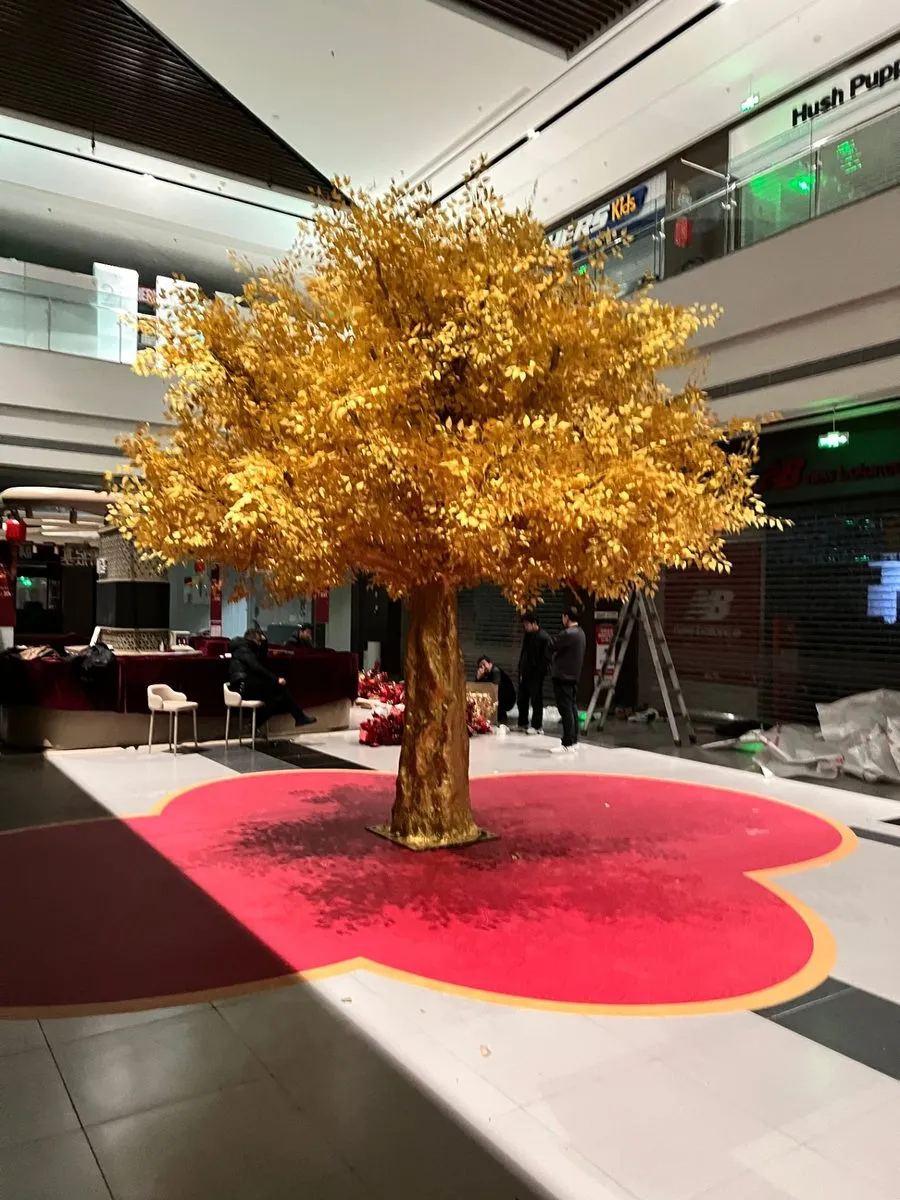
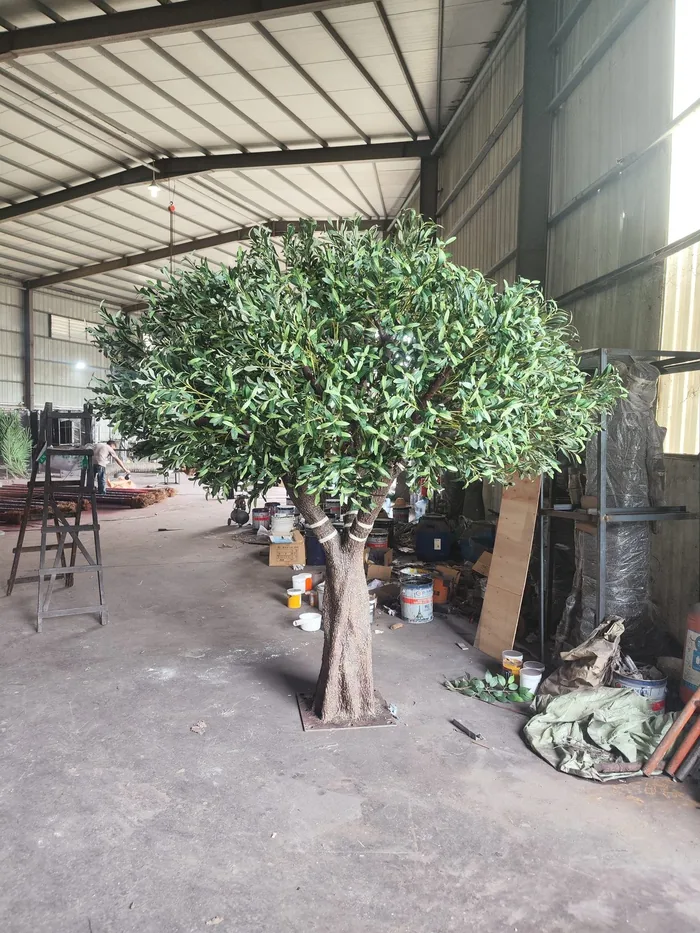
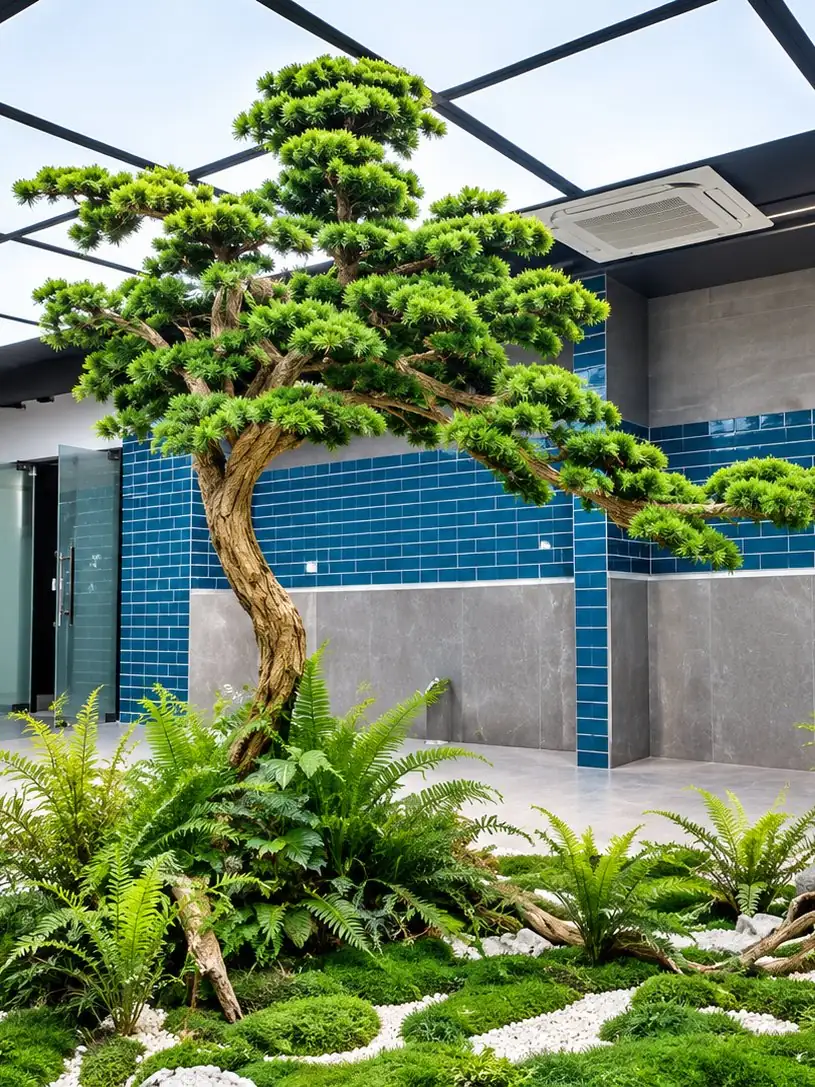
Executive Summary
A home greenery kit arrives as three to four flat boxes: pre-wired frond sets, a knock-down trunk in two or three joints, a weighted base and a pot. A 2.2 m tree packs into about 0.22 m³ at 11–14 kg and assembles in 45–60 minutes with one person and a hex key, no drilling and no watering.
1. What Goes Wrong Without This
Most disappointing home greenery purchases fail on logistics rather than on looks. The tree is fine in a photograph and wrong in a lift, a doorway or a room with a 2.4 m ceiling.
The tree is bought at the height of the room, not the height of the delivery route. A 3.6 m specimen that ships assembled needs a 3.9 m clearance to be carried upright and a lift with a 2.4 m internal height. In a villa with a service stair it may never reach the room it was bought for, and the return freight on an assembled tree costs more than the tree.
The pot arrives as an afterthought. A 2.2 m tree in a 30 cm pot is a top-heavy object. Buyers who choose the pot for its look rather than its mass end up with a tree that tips when a door slams, and the usual fix — a bag of sand in the pot — is the reason the pot cracks at the base.
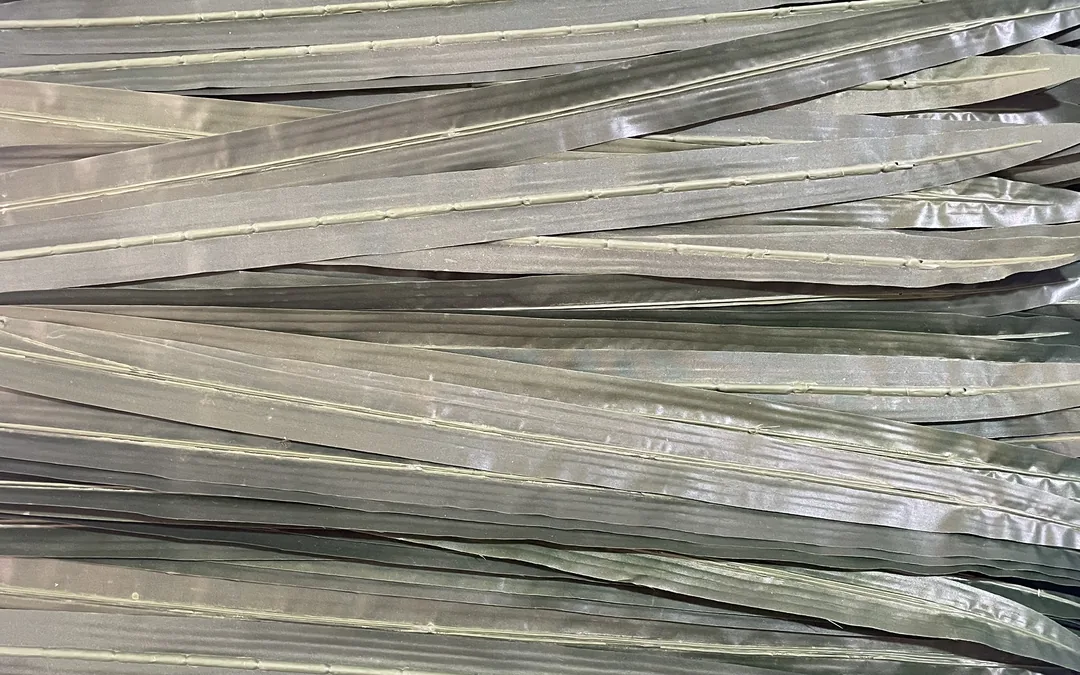
The fronds are compressed into a box that is too small. Flat-packing is the right answer for volume, but a frond set folded past its natural curve takes a permanent bend. It hangs wrong at the top of the canopy for months, and no amount of steaming fixes a crease that has set in a PE moulding.
Assembly instructions assume a workshop. A kit that needs a drill, two people and a ladder for a 2.2 m tree is mis-specified for a home. The parts that should be tool-free — the trunk joint, the base collar, the frond clips — are exactly the parts where suppliers cut cost.
The finish smells of solvent for a week. A PU-coated trunk and a freshly printed leaf face can carry residual solvent into a closed room. A kit that has been sealed in a carton for four weeks needs an airing period, and a spec sheet that says "no odour" without saying how long is a spec sheet that has not been checked.
Colour does not match the room. Warm-white lighting at 2700 K pulls a green towards yellow; 4000 K retail lighting pulls it towards blue. A canopy chosen from a supplier photo taken under daylight can read flat or synthetic in a living room, and the mismatch is only visible once the tree is standing in it.
2. The Decision Framework
Six checks settle most of the choice before a kit is ordered. They take an afternoon with a tape measure and they remove the two failure modes that cannot be fixed after delivery: the route and the base.
Check 1 — Measure the route before the room. The longest packed component sets the route requirement, not the assembled height. Kits ship with a longest pack of 1.1–1.5 m, which passes a standard 0.8 m door and a passenger lift. An assembled tree above 2.6 m does not, so anything taller is specified as a knock-down kit by definition.
Check 2 — Match height to ceiling, not to taste. In a room with a 2.4 m ceiling, a 2.0–2.2 m tree leaves 20–40 cm of air and reads correct; a 2.6 m tree reads cramped and hides the ceiling line. In a double-height villa living room of 5.5–6.0 m, a 3.4–4.2 m tree fills the void without touching the light fittings, and a 2.4 m tree disappears.
Check 3 — Size the base to the top load. The base is the safety device. A tree of 2.2 m needs a base or planter of 11–14 kg; 3.4 m needs 20–26 kg; 4.6 m needs 34–42 kg. Where the pot is decorative and light, the kit includes a steel plate that sits inside it, and that plate is the number to check on the packing list.
Check 4 — Count frond sets against the canopy volume. A 2.2 m canopy takes 10–14 frond sets, a 3.4 m takes 18–24, a 4.6 m takes 28–36. Below the lower number the canopy shows gaps at eye level; above the upper number it reads as a solid mass and loses the branch structure that makes it convincing.
Check 5 — Read the joint, not the photo. A home kit joint should be a machined socket with a spring pin or a collar with two grub screws, engaged by hand. A joint that needs a mallet is a joint that will be loose after two seasons. Ask how many joints the trunk has: two for 2.2 m, three for 3.4 m, four for 4.6 m.
Check 6 — Confirm the finish and the airing. PE foliage with a matte face and a PU or fibreglass trunk should have no solvent smell after 24–48 hours out of the carton. Ask what the trunk is finished with and whether the leaf face is printed or moulded in colour; printed faces scuff white at the fold, moulded faces keep their colour through a bend.

3. Numbers, Tiers and Timelines
| Kit tier | Assembled height | Pieces in the boxes | Packed volume and weight | Assembly time | Room it fits |
|---|---|---|---|---|---|
| Compact | 2.0–2.2 m | 3 boxes, 10–14 frond sets, 2 joints | 0.20–0.24 m³, 11–14 kg | 45–60 min, one person | Apartment living room, 2.4–2.6 m ceiling |
| Living room | 3.0–3.4 m | 3–4 boxes, 18–24 frond sets, 3 joints | 0.34–0.40 m³, 20–26 kg | 80–100 min, one person | Villa living room, 3.6–4.2 m ceiling |
| Double height | 4.2–4.6 m | 4 boxes, 28–36 frond sets, 4 joints | 0.58–0.66 m³, 34–42 kg | 2.5–3.5 h, two people | Double-height hall, 5.5–6.0 m void |
| Balcony pair | 1.6–1.8 m each | 2 boxes per tree, 8–10 frond sets | 0.14–0.18 m³ each, 8–11 kg | 30–40 min each | Covered balcony, 2.4 m headroom |
Three numbers in the table drive the buying decision. Packed volume decides the delivery charge, because a door-delivered consignment is priced on cubic metres rather than on weight. Assembly time decides whether the kit is a weekend job or an evening job. And the base weight decides whether the tree is safe in a room with children, a robot vacuum or a balcony door that catches the wind.
Delivery timing runs 30–45 days door to door on a consolidated consignment, made up of 7–10 days of production for a standard build, 15–20 days for a custom height, and 18–25 days of sea transit plus clearance. A kit ordered for a specific room should be ordered before the flooring goes down, not after the furniture arrives.
4. How to Apply It to a Live Project
The sequence below is what a homeowner or an interior designer actually does, in order, from order to the first dusting.
Order: give the supplier the room, not just the species. Ceiling height, floor finish, the route from the door, and a photograph of the corner are enough to specify height, base weight and pot diameter together. A supplier quoting a height without asking for the ceiling is quoting a product, not a fit. Kits of the same tier installed in comparable rooms are grouped in recent projects, which is a faster reference than a dimension table when the room is unusual.
Delivery: check the carton count against the packing list before signing. A four-box kit that arrives as three boxes is missing a frond set, and the missing box is not recoverable from a photograph taken a week later. Check the longest box for crush damage at the ends, where the trunk joints sit.
Unpacking: lay the parts out and let the fronds hang for an hour. Frond sets that have been folded in a carton relax once they are out. Assembling immediately produces a canopy with a set that stays visible for weeks. An hour on a flat surface is enough at room temperature.
Assembly: build from the base up, and leave the top joint last. Fit the base plate into the pot, seat the first trunk joint, add the second and third, then hang the frond sets from the bottom ring upward. The top joint goes in last so the canopy can be turned to face the light before it is locked. A 3.4 m kit is a two-step-ladder job for the top two rings.
Placement: keep 40–60 cm from a heat source and out of direct afternoon sun. PE foliage holds colour indoors for years but a south-facing window in a hot climate will shift a green over two summers. On a covered balcony, specify the UV-stabilised face and keep the tree out of driven rain.
Finishing: weight, level, and a felt pad. Confirm the base is level before the canopy goes on; a 3.4 m tree on a 3 mm slope leans visibly at the top. A felt pad under the pot protects a timber floor and stops the assembly walking when it is nudged.
Maintenance: dust every six to eight weeks with cold air from a hairdryer on its lowest setting, held 20 cm away. No water, no feed, no leaf shine. A damp cloth on the trunk twice a year is the whole routine, and it is the reason a kit suits a household that travels.
5. Commercial Contractor FAQs
Do I need tools to assemble the kit? A hex key is supplied for the base collar and the joint grub screws, and nothing else is needed below 3.4 m. A 4.2–4.6 m kit needs a two-step ladder for the top rings and a second person to hold the canopy while the top joint is locked.
How heavy is the box, and can one person carry it? A 2.2 m kit ships at 11–14 kg in three boxes, so each box is 4–6 kg and one person carries it upstairs in two trips. The 3.4 m kit runs 20–26 kg across three or four boxes, and the 4.6 m kit 34–42 kg across four, where the base plate is the single heaviest item at 12–18 kg.
Will it smell of plastic in a closed room? PE foliage and a PU-finished trunk should have no solvent odour after 24–48 hours out of the carton. Kits are air-cured before packing, and a kit that still smells after two days in a warm room has been packed too soon after finishing.
Can the height be changed later? No, and that is worth knowing before ordering. Height is set by the trunk joints and the frond count, so a 2.2 m kit cannot become a 3.4 m tree. Ordering one size up and stopping the canopy short is not a workable shortcut either, because the joint spacing shows.
How is it delivered, and who carries it in? Door delivery on a consolidated consignment, 30–45 days from confirmation. The carrier delivers to the door rather than into the room, so a 4.6 m kit needs somebody at home to move four boxes, and a villa with a gate needs the delivery note to name the gate.
Project Engineering Support & CAD Requests
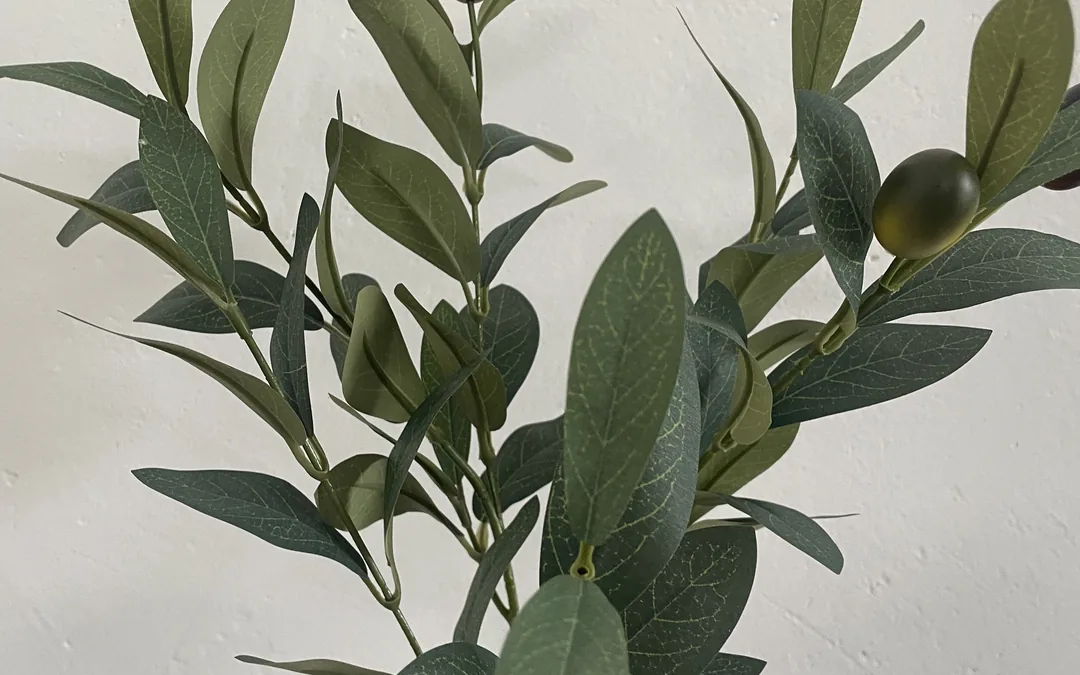
We build home kits the way we build project trees: the packing list names every box, the joint count, the base weight and the frond count, because those four numbers decide whether a tree fits a room and a route. Send us the ceiling height, the room photograph and the route from the door, and we will return a kit size, a base weight, a pot diameter and a box list, with a door-delivered timeline against your date. Custom heights are cut to the room rather than rounded to a catalogue size, and the same drawing set covers a mediterranean olive for a living room, a fan palm for a balcony corner, or a pair for a double-height hall. Where a project needs a matched pair or a size outside the standard tiers, we quote it from the drawing rather than from the list.
👉 Chat with Structural Engineering on WhatsApp (Instant Project Review)