Artificial palm trees specified for Dubai commercial work run 4–10 m on a Q235 hot-dip galvanized steel core at Ø60–114 mm with a 3–5 mm wall, UV50+ polyethylene fronds rated for a 50°C surface temperature and a documented 3–5 year colour-fastness window under ASTM G154 accelerated weathering. Base anchoring is engineered to a 32 m/s design wind speed. Foliage carries NFPA 701 as standard, with EN 13501-1 B-s1,d0 available for GCC tender packages.
📊 The construction pipeline those projects draw on is large enough to be quoted. The UAE construction market was projected at USD 120.82 billion in 2025, USD 127.13 billion in 2026 and USD 167.27 billion by 2031, a 5.64% CAGR, with infrastructure — the roads, utilities and public realm work that carries most streetscape planting — growing fastest at 5.23% (source). Hospitality fit-out is procured in the final twelve to eighteen months of each programme, so a broad pipeline compresses a great deal of foliage demand into a narrow window — which is why lead times and certification scrutiny both tighten as the pipeline peaks, not after it. The artificial flowers, foliage and fruit category is now large enough that dedicated Middle East market reports cover it as its own segment (source).
The framing below is written for the buyer who has to defend the specification at handover: a hotel or mall procurement lead, a landscape architect issuing a tender package, or a fit-out contractor holding a fixed opening date. Every dimension, class and test cited here can be verified against the submittal documents before production starts.
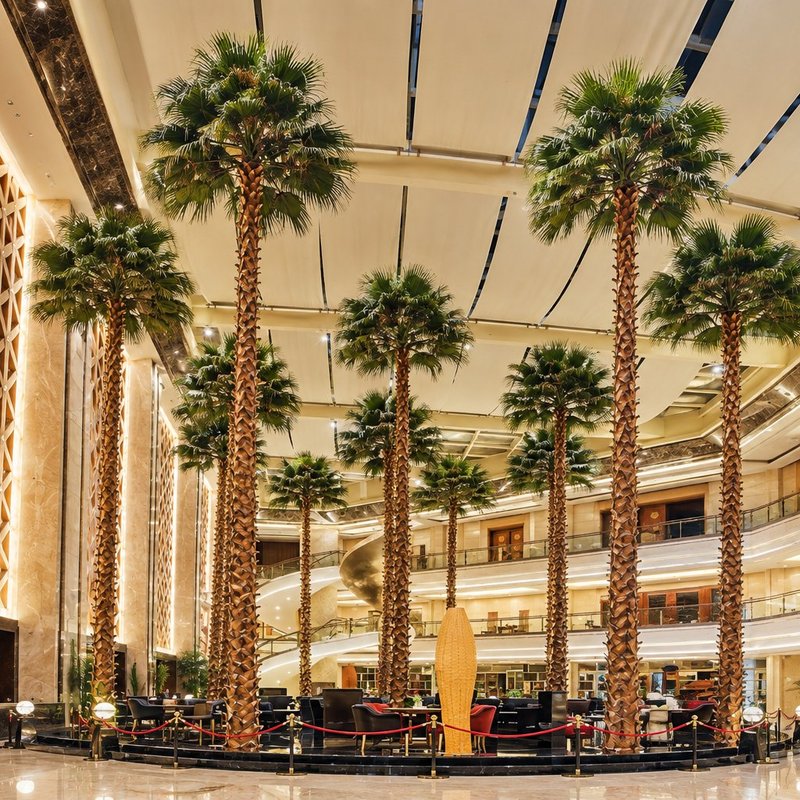 Artificial palm trees in a marble hotel lobby palm court — the "fewer, larger focal pieces" pattern now standard across Dubai hospitality interiors.
1. Failure Modes & Commercial Pitfalls
Most Dubai palm specifications that underperform within two years fail on three specific points, and all three are visible before the order is placed.
Single-shade injection moulding. A frond moulded from one flat pigment reads as plastic at ten metres and fades toward a uniform grey-yellow under Dubai's UV load. Commercial-grade fronds blend two or three shade variations into each leaf so light passes through the way it does in a living palm. Flipping a sample frond over is the fastest field test available: identical colour on face and underside means single-shade stock, whatever the spec sheet says.
Surface-applied flame retardant. A topical treatment sits on the polymer and abrades away with dust-wiping, cleaning cycles and direct sun. The certificate is valid at handover and stale by the first civil-defence walk-through. Retardant compounded into the resin before moulding does not wear off, which is why the two treatments behave identically on day one and completely differently in year three.
Under-ballasted bases. A 7 m palm on a pool deck or porte-cochère is a lever, not a plant. Wind load, guest traffic and cleaning plant all act on it laterally, and a decorative pot filled with sand on site is not a ballast calculation. The failure mode is a tipping incident rather than a cosmetic complaint.
One further pattern matters here. The current design preference is one or two large focal palms establishing scale in an atrium or entrance, rather than a dozen smaller units filling the same floor area. That moves the engineering risk from foliage to base design: fewer, taller specimens mean every anchor is a critical one.
The list of failure modes that gets missed is short and unglamorous. Mismatched trunk diameter at the joint. On the rare tall specimen that travels in more than one piece, a step at the joint reads as a seam from ground level and cannot be corrected on site. Foliage out of sequence. Fronds are numbered for the crown they belong to; a mixed pallet means fronds that do not sit at the designed angle and a crown that looks thin at the top. Certificate naming the wrong line item. A fire report issued against a generic "artificial foliage" category rather than the specific frond material supplied is a documentation risk, not a product risk, and it surfaces late. None of the three is a manufacturing defect — all three are procurement and documentation decisions made weeks earlier.
There is also a commercial arithmetic that regularly surprises first-time buyers: the visible tree is a small share of the delivered cost. Most palms ship fully assembled and braced on timber saddles inside the container; only the very largest specimens, or anything that will not clear a standard container headroom, travel in more than one piece and are joined on site. That makes the packing plan — not the unit price — the figure that determines how many units fit in a 40 ft high-cube. A supplier who quotes a unit price without a piece-by-piece CBM sheet has not quoted the delivered cost yet. Request both, and request them before the purchase order rather than after.
2. Material Science & Structural Engineering Standards
Structural core. Palm builds use Q235 hot-dip galvanized steel tubing at 3–5 mm wall thickness, with continuous fillet welds at the crown joints (AWS D1.1-class shop welding). Core diameter scales with height: Ø60 mm at 4–5 m, Ø89 mm at 5–7 m, Ø114 mm above 7 m. Below those diameters a tall crown deflects under its own weight plus wind, the frond tips splay outward, and the silhouette loses the vertical read the design depended on. Timber or foam cores cannot hold the same stiffness-to-weight at height without visible external bracing.
Trunk. Centrifugal fibreglass cast from a real palm trunk reproduces the ring geometry and the fibre texture between rings. A structural steel spine runs through the shell, so the trunk is load-bearing rather than decorative — the distinction matters at 8 m, where the crown load is carried by the spine and the trunk shell only resists surface damage.

Fronds. UV-stabilised polyethylene, pre-shaped and numbered at the factory. Frond count is the density metric that drives how the crown reads from a distance: 90–120 fronds for 4–5 m, 120–150 for 5–7 m, and 150–180 above 7 m. Under-counting is the usual cost-reduction move and shows up as a sparse crown that reads as artificial from the mezzanine level.
What to ask for instead of a generic UV claim. Ask for accelerated weathering hours (ASTM G154 or ISO 4892-3) and the colour-fastness window those hours support. A supplier letter saying "UV-resistant" and a 3,000-hour test report are not the same specification, and only one of them survives a client review. ASTM G154 exposes samples to repeating cycles of UV-A lamp radiation and condensation at controlled temperature, and a report should state total radiant exposure in kJ/m² alongside the hours, because hours alone mean little without the irradiance level that produced them.
Fasteners and dissimilar-metal contact. A galvanized core bolted to a stainless or aluminium component in a humid coastal atmosphere is a galvanic couple waiting to corrode. Specify isolation washers or a coated interface wherever the anchor package mixes metals, and confirm the base plate and the slab insert are treated as one assembly rather than two line items. This is an inexpensive detail at drawing stage and an expensive one after installation.
Why fibreglass is cast rather than printed. Trunk texture is taken from a real palm, then reproduced by centrifugal casting so the ring geometry and the fibre relief between rings carry through. The resulting shell has the surface depth that a viewer's eye reads as bark; a smooth moulded shell with a printed texture pattern tends to read as flat under the direct, hard sunlight typical of a Gulf plaza, where there is very little diffuse light to soften a surface. The casting method also determines how repairable the trunk is: a cast shell can be locally refinished and colour-matched on site, whereas a printed surface has to be replaced as a unit.
The comparison that matters at tender stage is not "real versus artificial" but "which artificial build holds its geometry for the maintenance cycle the client will actually run". Ask for a sample trunk section and a completed installation that is at least three years old. Both requests are reasonable, and the answers separate suppliers more reliably than any datasheet.
Steel Core vs Aluminium Core: Which One to Specify
Both cores are specified in the GCC, and the choice is driven by height and exposure rather than by cost alone.
| Property | Q235 Hot-Dip Galvanized Steel | 6061-T6 Aluminium |
|---|---|---|
| Stiffness (Young's modulus) | ~200 GPa | ~69 GPa |
| Own weight at equal stiffness | Heavier | Lighter by roughly 60% |
| Corrosion strategy | Zinc coating; needs intact coating at cut ends | Naturally passivating oxide layer |
| Galvanic risk with stainless fixings | Moderate — specify isolation washers | Low |
| Suitable height band | 4–10 m | 3–5 m, or where roof loading is critical |
| Repair after impact | Local refinish plus re-coating | Section replacement |
| Relative material cost | Lower | Higher per metre |
Specify steel where the governing constraint is crown load at height, which covers most 5 m-plus installations and anything in an exposed wind position. Steel's higher modulus means a smaller diameter can carry the same bending moment, so the core stays hidden inside the fibreglass trunk instead of forcing a thicker shell that reads as over-built. The trade-off is corrosion management: every cut end and drilled hole in a galvanized section is a fresh exposure point and needs a zinc-rich touch-up, which is a workshop discipline rather than a specification line.
Specify aluminium where the governing constraint is weight on the structure rather than stiffness — a rooftop terrace, a podium garden with a load limit, or an installation where the tree must be lifted by hand into a finished interior. It will not corrode in a coastal atmosphere and it does not need coating maintenance. The cost is that at 7 m an aluminium core of equivalent stiffness becomes a visibly larger tube, and the trunk shell has to grow to hide it.
The honest answer for most Dubai work is steel for the trees over 5 m and aluminium for the cluster of smaller units around them, specified as two line items rather than one. A supplier who offers only one of the two is not necessarily wrong, but they are selling a constraint rather than a solution.
3. Life Safety, Fire Codes & Environmental Compliance
NFPA 701 is the reference most GCC foliage submittals use. Method 1 applies to single-layer frond material; Method 2 covers a heavier or multi-layer assembly. The certificate must name the frond material actually supplied and the assembly as installed — a pass on loose stock does not cover a dressed canopy, and reviewers increasingly check that the report line item matches the product line.
EN 13501-1 Class B-s1,d0 is the common European requirement and is written into a growing number of GCC tender documents alongside NFPA. Inherently flame-retardant polymer meets the class as a material property; topically treated polymer holds it only for as long as the coating survives.
The practical compliance risk in the GCC is procedural rather than technical. UAE and Saudi civil defence authorities run pre-opening inspections, and foliage documentation is one of the items on the checklist. A certificate naming the wrong product line, or an assembly that was never tested as assembled, tends to surface about six weeks before opening — when re-supply is not on the programme.
📊 Read the class notation, not just the letter. EN 13501-1 grades reaction-to-fire performance across the full Euroclass scale, derived from the harmonised European test methods for building products — A1 and A2 for non-combustible, B through F for combustible — plus an s1–s3 suffix for smoke production and a d0–d2 suffix for flaming droplets (source), and the correct reading is the base class and the suffix pair taken together. Class B-s1,d0 is the practical target for interior foliage: limited contribution to fire, minimal smoke and no flaming droplets. A supplier who can explain why a specific test assembly qualifies under that notation is a stronger signal than one who simply writes "B-s1,d0 compliant" on a quotation, because the suffix pair is where a marginal product usually fails.
For outdoor-only plantings the fire requirement usually drops away and the governing test switches to weathering and wind. Where a scheme straddles both — a covered walkway opening onto a pool deck, for example — the safest design decision is to specify the higher interior class across the whole zone. The cost difference is small at approval stage and material at re-work stage.
4. Technical Comparison Table
| Tree Height (m) | Min Core Steel Ø (mm) | Frond Count (canopy) | Floor Live Load & Ballast (kg) | Application | Indoor/Outdoor |
|---|---|---|---|---|---|
| 4–5 | 60 | 90–120 | 220 (ballast collar) | Hotel lobby palm court, mall atrium | Indoor |
| 5–7 | 89 | 120–150 | 380 (ballast collar) | Resort poolscape, city streetscape | Outdoor |
| 7–10 | 114 | 150–180 | 520 (slab-anchored) | Beachfront feature, theme park plaza | Outdoor |
All versions: hot-dip galvanized core, UV50+ PE fronds, numbered fronds for site assembly. Wind load is sized per site survey rather than taken from a generic chart. Heights above 6 m in exposed positions require the slab detail in §5.
5. Structural Anchoring & MEP Coordination
Two mounting approaches cover most projects. Up to roughly 5 m, a ballast collar inside a decorative planter — a 600 × 600 × 12 mm steel base plate on four M12 bolts, centre of gravity kept low inside the collar — resists lateral load from wind and cleaning plant. Above 6 m, or wherever the planter is too shallow to develop the required ballast, the trunk flange bolts directly to the structural slab, with the connection concealed below the finished floor.

MEP coordination is where Dubai programmes slip. The crown must clear sprinkler throw, and the anchor passes through the same fire-rated slab that the sprinklers protect, so the anchor drawing and the fire-submittal package should be issued together rather than sequentially. On a planted palm court, confirm whether any irrigation line at the base location is live, capped or removed before the planter is set — a redundant live line under a ballast collar is a leak waiting for the first summer.
Wind is a site condition, not a catalogue figure. The 32 m/s design wind speed used throughout this guide is a starting point for a sheltered urban installation, not a universal number. Exposed beachfront, elevated terraces and open plaza positions develop higher local pressures, and a podium-level location can experience accelerated flow between buildings that a ground-level chart does not capture. The anchor calculation should be produced against the site's own wind value, and the calculation should state the assumed exposure category and the height above grade it was based on. A calculation sheet that omits those two inputs is not reviewable.
A worked sequence that avoids re-work. Survey the base and record the slab thickness and any existing penetrations first; issue the anchor and fire package together; produce the packing plan once heights are frozen, not once the order is placed; and confirm the delivery route into the building before the finished floor is protected — most palms arrive assembled, so the door headroom and turning radius matter more than the tree itself. Each of those four steps is cheap on its own and each one, skipped, is capable of moving an opening date. The most common single cause of delay in this category is not the tree — it is discovering at installation that the base detail and the fire-rated build-up disagree, and having to reopen a completed floor.
6. Commercial Contractor FAQs
Q: Does a hotel palm court count as indoor or outdoor for fire review?
A: The enclosure decides it, not the planting. A glass-roofed lobby with sealed HVAC is reviewed as an interior occupancy and needs inherently flame-retardant foliage with NFPA 701 documentation. A walkway open to the outside falls under exterior-landscape review instead. Several Dubai atria need both ratings across a single planting scheme, which is easiest to satisfy with a material that holds the class inherently rather than by coating.
Q: How long before the fronds visibly fade in Dubai?
A: UV-stabilised PE fronds hold colour for 3–5 years in high-exposure positions such as a porte-cochère, pool deck or unshaded plaza, and that window should be supported by accelerated weathering hours rather than a general UV statement. Shaded or covered specimens last longer because the UV dose is lower, not because the material differs, so one specification can serve both if the exposure map is done properly.
Q: Can a 7 m palm be assembled inside a finished building?
A: Yes. The crown is built out on site around a trunk that is already standing in position, rather than craned in as one piece: fronds are numbered for the crown they belong to and fitted in sequence. Access and lift planning then matters more than the tree itself: confirm the route, the door headroom and the working radius before the installation date is fixed.
Q: Which documents should travel with the submittal?
A: A fire test report naming the supplied frond material and the assembly, accelerated weathering data, a ballast or anchor calculation for the specified height and site wind speed, and a piece-by-piece packing sheet. The packing sheet also sets the container yield, so procurement benefits from seeing it before the purchase order rather than after.
Conclusion: Lock the Core Diameter and the Fire Certificate Before You Lock the Price
The two decisions that determine whether a Dubai palm package succeeds are made early: the core diameter for each height, and the fire documentation for the material actually supplied. Both are engineering choices, both are checkable against documents, and both are far cheaper to settle at tender stage than at inspection stage. Price is the third decision, and it is the only one that is easy to reverse — a supplier who will not issue a stampable anchor calculation and a line-item fire certificate is not a cheaper supplier, only a later problem.
Our manufacturing team builds to these specifications rather than around them. For a Dubai or wider GCC palm package we issue stamped shop drawings, the fire-certificate pack (NFPA 701 as standard, EN 13501-1 on request), UV test data, and physical finish swatches for trunk texture and frond colour sign-off before production begins. Send the clear height, the base or planter dimensions, the site design wind speed and the venue fire standard; we return a structural sketch, a ballast calculation and a lead time.
- CAD drawings (.DWG / .STEP files) and a ballast calculation for the specific height and base.
- A material sample swatch box — trunk shell sample plus UV50+ frond swatches — for finish sign-off.
- See King Palm Tree, Date Palm Tree and the wider product range for the palm SKUs these specifications apply to.
- For a hotel or mall scheme at master-plan stage, the Custom Solutions route covers multi-species packages and drawing coordination.
👉 Chat with Structural Engineering on WhatsApp (Instant Project Review)


