Executive Summary
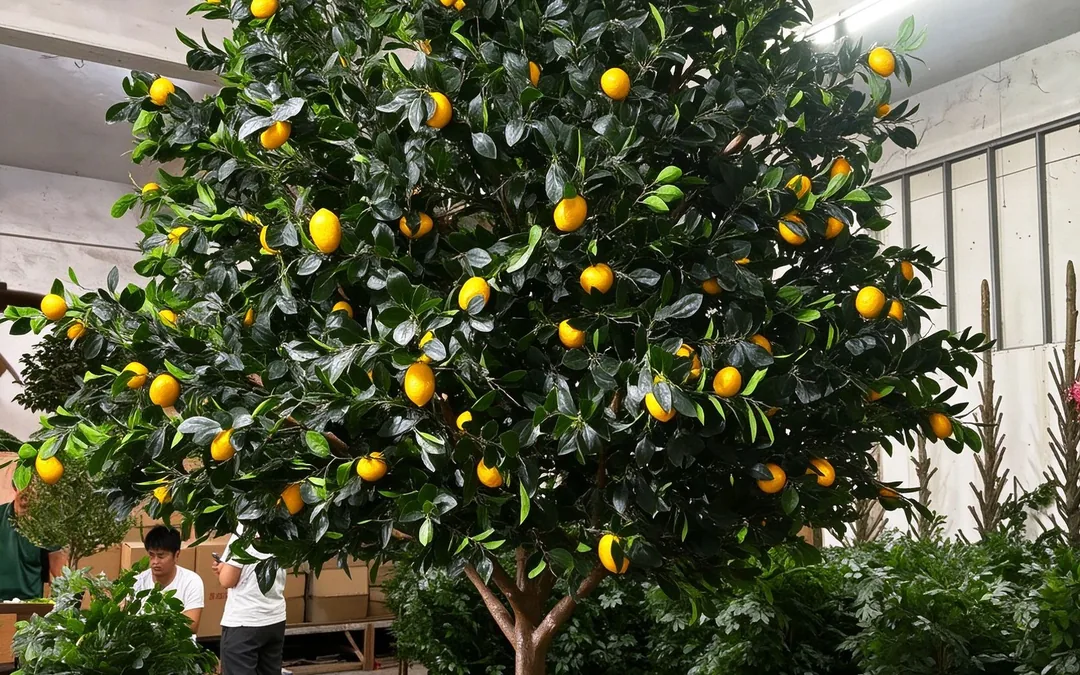
A balcony lemon tree works at 120–180 cm in a pot of 45–60 cm diameter weighing 9–16 kg with the fruit attached. One 150 cm tree arrives in two cartons, assembles in about five minutes with one hex key, and needs no watering, no soil and no direct sun. Below 9 kg of pot weight, a 6th-floor balcony with 1.5 m railings is a wind problem waiting for the first shamal.
1. What Goes Wrong Without This
A balcony is a harsher environment than most buyers expect, and the failures are predictable.
The tree is taller than the railing and the wind knows it. Balconies accelerate wind at the corner and along the parapet. A 180 cm tree with a full canopy presents roughly 1.1 m² of sail area; at 15 m/s — a normal gust on a coastal tower — that is about 190 N of lateral force at canopy height. A 6 kg pot with a 40 cm base tips. The fix is not a heavier tree, it is a heavier pot and a wider base, and it has to be decided before the order rather than after the first storm.
Sun through glass or a west-facing slab. Lemon foliage is bright yellow-green, and a dyed polyethylene leaflet that is not UV stabilised shifts toward olive within a season on a west balcony. The colour change is gradual, which is exactly why it gets missed until the tree no longer matches the photos on the listing.
Assembly that looks assembled and is not. Two-piece trunks joined with a plastic collar and no locking pin wobble by 3–5 mm at the joint. On a tiled balcony that reads as a loose tree every time somebody brushes past, and the joint loosens further with each season.
A pot that is too light for its own canopy but too heavy to move. A balcony owner needs to shift the tree for cleaning twice a year. A 60 cm concrete pot at 28 kg does not move without help; a 9 kg composite pot with a weighted base does.
Delivery that stops at the kerb. A 150 cm carton is 160 × 40 × 40 cm, roughly 0.26 m³, and it will not fit in a lift with a passenger or through a 75 cm door frame unless it is packed in two pieces. Where the freight terms are FOB or CIF, the last kilometre becomes the buyer's problem — and in a tower with a service lift booking system, that problem can cost a day and a handling fee.
An unboxing smell. Cheap compound with residual plasticiser smells like a new shower curtain for a week in a closed apartment. Low-VOC moulding and a proper post-cure remove it, and it matters more on a balcony than in a lobby because the air movement is limited and the door is usually open.
2. The Decision Framework
Six checks settle the choice, and each one is answerable from a tape measure and a delivery note.
1. Height against railing and ceiling. Measure the clear height from balcony floor to the underside of any overhead slab or awning, then subtract 20 cm. A tree that ends level with the railing top hides the view; 20–30 cm above the railing reads as a tree rather than a hedge. On a typical 1.05 m railing, that puts the sweet spot at 130–150 cm, not 180 cm.
2. Pot diameter against wind exposure. Under 40 cm base diameter is for a recessed balcony up to the 3rd floor. 45–50 cm for a mid-rise balcony with one open side. 55–60 cm and a weighted base for anything above the 8th floor or a corner balcony with two open sides. The mass that matters is pot plus ballast, not the tree.
3. Foliage compound and UV rating. Ask for the compound, not the colour. Injection-moulded polyethylene with a UV stabiliser holds colour on a balcony; silk does not, and it also holds dust and salt. If the listing says "premium realistic leaves" with no material named, assume silk. The same rule applies to the rest of the artificial citrus range, where leaflet density varies far more between suppliers than the product photos suggest.
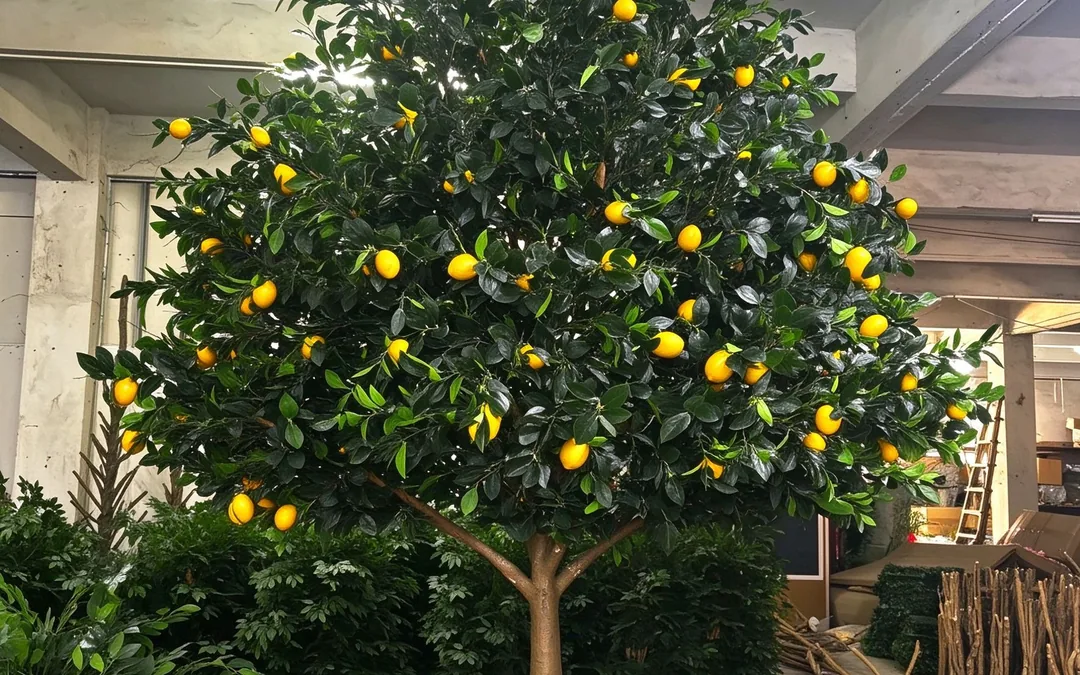
4. Fruit attachment. Lemons are the piece that falls off in transit and in handling. Good fruit is moulded onto the branch with a stem socket, not glued onto the surface, and it should survive a firm pull by hand. Ask how many spare fruits ship with the tree; two or three is normal.
5. Joints and assembly. Two-piece trunks should have a steel sleeve plus a locking pin or bolt, not a push-fit collar. Assembly should need one hex key and no tools beyond that, and the joint should be invisible at 1 m. If assembly needs glue, it is not a balcony product.
6. Delivery terms. DDP means the tree arrives at the apartment door with duty and local delivery paid. FOB and CIF stop at the port or the forwarder's warehouse, and the buyer arranges the last leg. For a single residential tree, DDP is almost always the cheaper total, because a one-off customs entry costs more than the freight difference.
The two checks that decide most purchases are the railing height and the delivery term. Buyers who get those wrong usually get everything else right and still end up with a tree that hides the view or a carton stuck in a lobby.
3. Numbers, Tiers and Timelines
The table covers the four sizes that account for most balcony orders. Pot weights are with ballast fitted; delivery days are door-to-door for DDP to a GCC city address.
| Height (cm) | Pot Ø (cm) | Cartons | Total carton weight (kg) | Assembly time | Price band (USD) | DDP delivery |
|---|---|---|---|---|---|---|
| 120 | 40 | 1 | 7–9 | 2–3 min | 78–120 | 12–16 days |
| 150 | 45–50 | 2 | 11–14 | 4–6 min | 120–180 | 12–18 days |
| 170 | 50–55 | 2 | 14–17 | 5–7 min | 165–240 | 14–20 days |
| 180 | 55–60 | 2–3 | 17–21 | 6–9 min | 195–290 | 14–22 days |
Two numbers are worth reading twice. The carton weight is not the tree weight — a 150 cm tree is around 4.5 kg of foliage and structure, and the rest is pot, ballast and packing, which is why the box feels heavier than expected and why the pot is the part that keeps the tree standing. The delivery window is measured from dispatch, not from order: production for a stocked size is 7–12 days, and a bespoke height adds two to three weeks.
Where a price sits far below these bands, the difference is normally in pot mass and fruit count. A 150 cm tree at 9 kg total is a 3 kg pot, and a 3 kg pot does not hold a 1 m² canopy on a balcony above the 5th floor.
4. How to Apply It to a Live Project
The sequence for a single apartment is short, and each step has one thing to confirm before moving on.
Step 1 — Measure the balcony. Clear height, railing height, the width of the door frame the carton must pass through, and the lift dimensions. A 150 cm two-carton pack needs a 160 cm carton; if the lift is 140 cm deep, confirm the carton can be carried upright or split further.
Step 2 — Choose height and pot from the two tables above. Fix the height against the railing, then the pot against the floor level and exposure. Do not size the pot by the tree's visual weight.
Step 3 — Confirm the material and the spares. Ask for the compound, the UV stabiliser, the number of spare fruits, and whether the pot has a removable ballast compartment. That last item is what makes the tree movable without emptying it.
Step 4 — Confirm the delivery term in writing. DDP to the apartment door, with the destination city named and any lift or stair charge stated. A quote that says "delivery to port" is not a delivered price.
Step 5 — Assemble on the balcony, not in the corridor. Open the cartons where the tree will stand. Fit the base into the pot, seat the upper trunk onto the sleeve, insert the locking pin, then shape the branches outward from the centre. Five minutes for a 150 cm tree; the shaping is what takes the time, not the joint.
Step 6 — Set the position and leave it. Lemon trees read well at one end of the balcony rather than centred, with the canopy clear of the railing by 15–20 cm. Wipe the leaves with a dry microfibre cloth every four to six weeks; that is the entire maintenance schedule, and it is the reason a balcony tree stays presentable through a summer when a real lemon would need daily water.
For a household buying two or three pieces — a lemon, an olive and a small palm — the same measurement logic applies, and ordering them together usually removes a delivery charge. Browsing the full artificial tree range before committing to a height is worth ten minutes: most buyers discover that the size they first pictured is one step shorter than the one that suits their railing.
One point on seasonality. Balcony stock is produced in batches, and a colour lot from a spring run does not always match a lot from autumn. Two lemon trees bought six months apart can differ by 3–4 ΔE, which is visible side by side on the same balcony and invisible across a room. Where a household plans to add a second tree later, note the lot number from the first carton label and quote it on the second order; a supplier who keeps lot records can match it, and one who does not will offer a colour that is close rather than the same.
5. Commercial Contractor FAQs
Q: Will an artificial lemon tree survive a balcony that gets direct afternoon sun?
Yes, if the foliage is UV-stabilised polyethylene. Ask for the compound and a UV test reference rather than a "fade resistant" claim. Unstabilised foliage shifts colour within one summer on a west-facing balcony; stabilised foliage holds for several years, and the pot and fruit are unaffected either way.
Q: How heavy is a 150 cm tree, and can one person move it?
Around 11–14 kg including pot and ballast, so one adult can move it a short distance but not carry it up stairs comfortably. Choose a pot with a removable ballast compartment if the tree has to be shifted for cleaning, and empty it first.
Q: Does it need to be anchored on a balcony?
A freestanding tree in a 45 cm pot is normally fine up to the 5th floor on a recessed balcony. Above that, or on a corner balcony with two open sides, add a weighted base or a discreet tie to the railing post. Drilling a tiled balcony floor is rarely worth it for a single tree.
Q: What arrives in the box, and what is not included?
Two cartons for a 150 cm tree: the pot with ballast in one, the trunk and canopy in the other, plus a hex key and two or three spare fruits. Soil, a decorative outer pot and any railing bracket are not included unless the listing says so.
Project Engineering Support & CAD Requests
We ship balcony trees as a two-carton DDP delivery with the pot, ballast and canopy packed separately so a single person can carry each box through a standard door. If a household is choosing between sizes, send the balcony dimensions and the railing height, and we will return the recommended height, pot diameter and carton split for that specific space.
👉 Chat with Structural Engineering on WhatsApp (Instant Project Review)