Executive Summary
A 3.0 m trade show maple that has to survive six re-installs a year needs a Q235 galvanised core of 60 mm OD at 2.5 mm wall, 2,400–2,800 leaves/m³ on an injection-moulded PE canopy, and knock-down sockets rated to 25–35 N·m per joint. Ask for NFPA 701 Method 1 data and the mould ownership document before the deposit leaves your account.
A booth tree is not a lobby tree. It is taken apart, cradled in a crate, flown to another city, rebuilt by a crew that has never seen it, and expected to look identical on opening morning. That duty cycle is what the audit should be built around — not the showroom photos. The questions below are ordered the way a factory visit actually runs: costing first, tooling second, structure third, paperwork last.
1. Failure Modes & Commercial Pitfalls
Four failures account for most of the disputes that follow a booth order. Each one is visible at the factory if you know which part to look at, and each one is invisible in a quotation.
Canopy creep on tall units. Above roughly 3.2 m, a canopy built on 8–10 mm branch rods will droop 60–120 mm at the outer tips within one exhibition season, more if the tree sits under 4000 K spots that raise surface temperature by 8–12 °C — the same failure shows up in a hotel atrium where the fixture is mounted 3 m away on a cove. The tree does not fail; it slowly loses the silhouette the client approved. On a booth, that silhouette is the whole purchase.
Socket fatigue at the knock-down joints. Booth trees are shipped collapsed. Every rebuild torques the same joint. An aluminium insert thread in a 1.5 mm wall tube will strip somewhere between the fifth and eighth cycle; a steel insert welded to a 2.5 mm wall will hold past twenty. The difference costs a few dollars per joint at the factory and a full replacement tree on site.
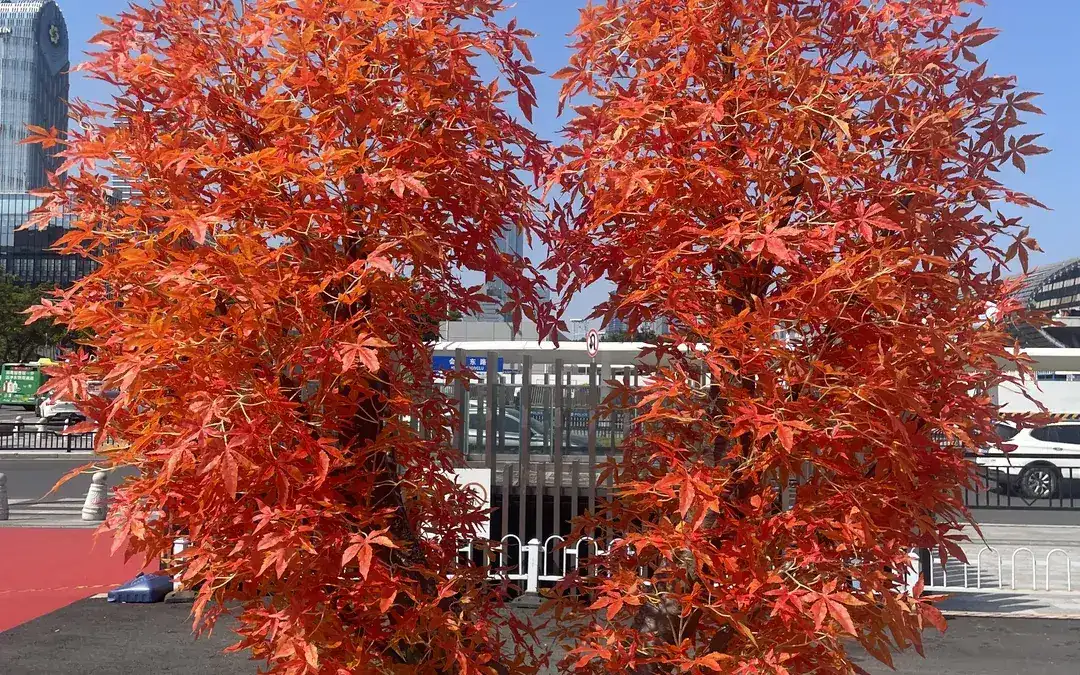
Dye-lot drift between the sample and the production run. Autumn colour is the one species where a ΔE of 4–6 is instantly visible: the sample reads as burnt orange under booth lighting, the delivered canopy reads as dull red. Two moulds, two resin batches, no retained control coupon — and there is no way to prove which one was approved.
A base that cannot be fixed to the floor. Most exhibition halls forbid drilling. A freestanding 3.5 m tree with a 12 kg plate will move when a cleaner's trolley clips it, and a venue safety officer who sees an unsecured 40 kg object beside a 1.2 m aisle can stop the build. The ballast calculation belongs in the quotation, not in the rigging crew's judgement on site.
The fifth failure is commercial rather than physical: a supplier who cannot answer tooling questions is passing your order upstream. That shows up as a three-week silence on a colour change, a first article that never arrives, and a lead time that moves after the deposit clears.
2. Material Science & Structural Engineering Standards
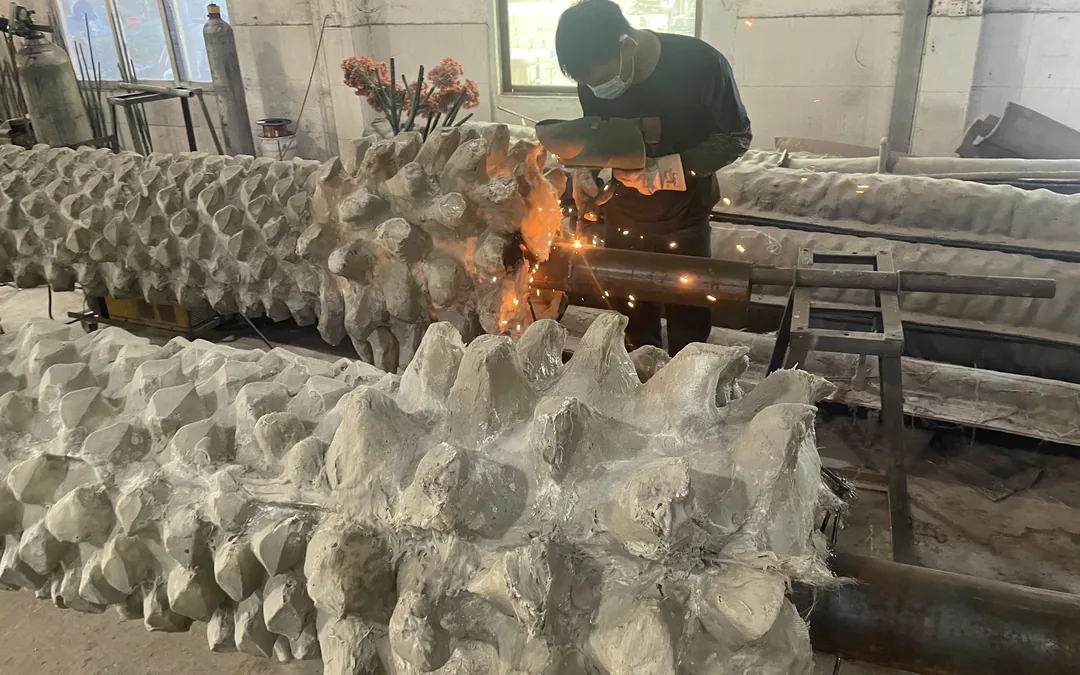
Core. Q235 galvanised steel tube, 48 mm OD at 2.4 m, 60 mm at 3.0 m, 76 mm from 3.6 m upward, with 2.0–3.5 mm wall depending on the load case. Welds are the audit point: a continuous fillet at every branch collar, no tack welds bridging a gap, and no visible undercut on the load-bearing side. Ask to see the welding bay and count the fixtures. A factory that welds freehand on the floor cannot repeat a 3.0 m frame to the same dimensions twice.
Bark and trunk skin. Centrifugal fibreglass laid into a silicone mould reproduces lenticels and bark fissures to about 0.3 mm and holds them for a decade. Polyurethane foam skins are cheaper per unit and lose definition within two summers outdoors; indoors they dent permanently at any point a crate strap crosses them. For a touring booth the deciding factor is not appearance but impact behaviour: fibreglass shells chip and can be touched up, foam compresses and cannot be recovered.
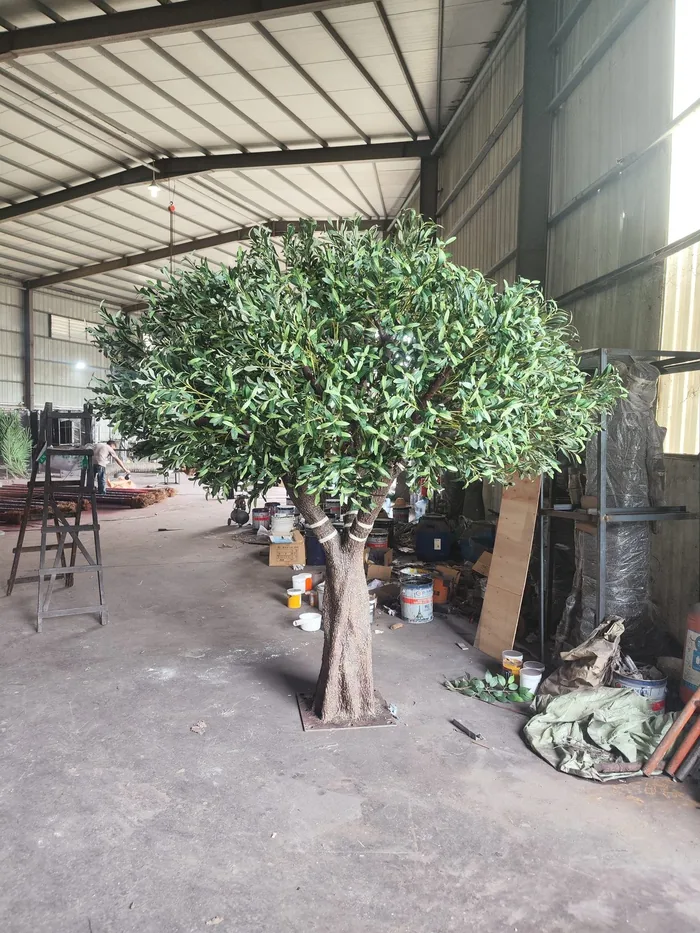
Foliage. Injection-moulded polyethylene leaves at 0.12–0.16 mm thickness with a matte UV-stabilised surface beat silk on every metric that matters in a hall: no fibre shedding onto black carpet, no crush memory after packing, no sheen under 4000 K lighting. Leaf density for a display-grade maple runs 2,400–2,800 leaves/m³; below 2,000 the canopy reads sparse from the aisle at 3 m viewing distance.
Mould ownership as a material proof. A maple canopy is not one mould. A usable range needs at least three leaf sizes and two colourways, which is four to six moulds plus the trunk shell tool. Ask which moulds exist, what steel grade they are cut from (718H or P20 are normal for this duty), the cavity count, and who owns them. A factory answers with numbers and can walk you to the rack. A trader has to come back to you with the question. Put the answer in the purchase order: moulds paid for by the buyer, stored at the factory, released on request.
3. Life Safety, Fire Codes & Environmental Compliance
Exhibition halls are treated as assembly occupancies, and the tree is decorative combustible material inside one. Three documents carry the argument.
NFPA 701. Method 1 is the small-scale vertical burn test used for films and thin sheeting; Method 2 is the large-scale test used for fabrics and dense foliage assemblies. For a canopy with a total exposed surface above roughly 1 m², venue fire officers in North America and most GCC halls expect Method 2 data, or Method 1 supported by a field test on the assembled unit. Ask for the test report number, the lab, and the date — and check that the report describes the same leaf weight and colourway you are buying. A pass on a 90 g/m² green leaf does not transfer to a 140 g/m² autumn canopy.
EN 13501-1. European and many GCC specifications classify the assembly rather than the film: B-s1, d0 is the usual target for a decorative feature inside an atrium or hall. Classification is only valid for the tested build-up, which means adhesive, leaf, and any fire-retardant topcoat applied after moulding. A supplier who applies a topical treatment at packing stage is selling you a classification that expires with the coating.
Indoor air and VOC. Closed halls recirculate. Freshly moulded PE with an unvented plasticiser load will off-gas for two to four weeks, and the smell is unmistakable in a 200 m² booth with the doors shut overnight. Require a declared cure period before packing — 14 days minimum for a booth order — and low-VOC adhesive data for the trunk wrap.
Labels. Every crate should carry the tree ID, the fire test reference, and the rebuild drawing number. On a multi-city tour this is what lets a local crew rebuild the tree without calling you.
4. Technical Comparison Table
| Tree Height (m) | Min Core Steel Ø (mm) | Leaf Density (leaves/m³) | Floor Live Load & Ballast (kg) | Application | Indoor/Outdoor |
|---|---|---|---|---|---|
| 2.4 | 48 × 2.0 | 2,200–2,500 | 18–24 kg ballast collar | Corporate HQ reception | Indoor |
| 3.0 | 60 × 2.5 | 2,400–2,800 | 28–35 kg collar or 4 × M10 into slab | 5-star hotel atrium | Indoor |
| 3.5 | 60 × 3.0 | 2,600–3,000 | 40–50 kg collar, 1.2 m aisle clearance | Mall atrium centre court | Indoor |
| 4.2 | 76 × 3.0 | 2,800–3,200 | 55–70 kg collar plus tie-back | Airport VIP lounge | Indoor |
| 3.0 (outdoor) | 60 × 3.0, hot-dip galvanised | 2,600–3,000 | 90–120 kg base plus 2 anchor points at 3 kN each | Seaside resort terrace | Outdoor |
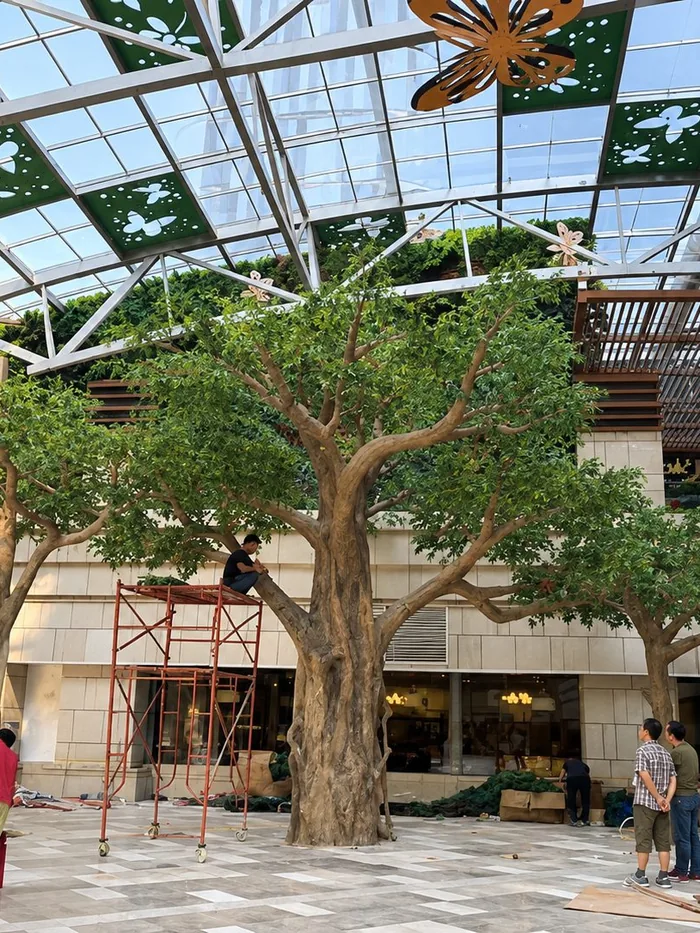
The jump from 3.0 m indoor to 3.0 m outdoor is not cosmetic. Wind load on a 1.8 m canopy at 32 m/s produces roughly 1.1 kPa of dynamic pressure; with a drag coefficient near 1.2 and a 2.5 m² projected area the overturning moment at the base is around 4–5 kN·m, which no ballast collar solves. Outdoor units need a plate and anchors, and the anchors need a structural slab to land in. Indoors, the same 3.5 m unit in a commercial atrium is limited by aisle clearance and deflector height rather than by wind.
5. Structural Anchoring & MEP Coordination
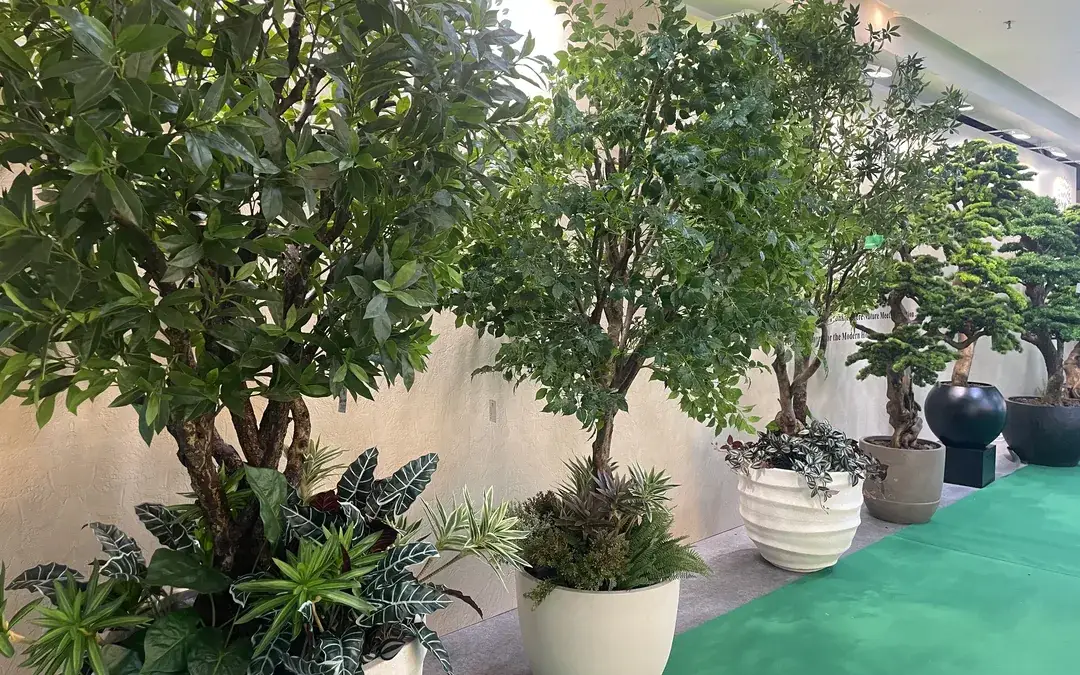
Two fixing strategies, and the venue decides which one you get. A ballast collar planter distributes 28–50 kg around the base and needs no permission from the building. A floor plate with chemical anchors transfers load into the slab and is the only correct answer above 4 m or outdoors. Most halls allow the first and forbid the second, so the tree height specified for a booth should be capped by what the floor will accept — usually 3.5 m for a collar, 5 m and above only with a rigging or slab approval.
Point load, not total weight. A 60 kg assembly standing on a 500 mm plate is a 60 kg point load on a floor rated at 500 kg/m² in aggregate. Most venues pass this without comment; a mezzanine or a temporary raised platform will not, and the calculation has to be shown. Where the geometry is unusual — a tree over a service trench, a tree tied to a balustrade — that becomes a custom anchor detail with a stamped drawing, not a catalogue part.
Sprinkler and air handling coordination. Keep the canopy 450–500 mm below the deflector line. A 4.2 m tree in a 4.5 m hall will sit inside the spray cone, and the fire officer will ask for it to be cut down after you have paid for it. Check the air curtain at the hall entrance as well: high-velocity downdraught at 3–4 m/s will strip leaves from a light canopy within a season, and it will move an unballasted tree on a smooth floor.
Rebuild documentation. For a touring unit, the deliverable is a one-page assembly sheet per tree: joint sequence, torque value (25–35 N·m), which branch goes to which socket, and the crate position of each part. This is the lowest-cost risk reduction in the whole order and almost never included unless asked for.
6. Commercial Contractor FAQs
Q: A three-city tour needs 14 trees. What is a realistic MOQ and lead time?
A: A mixed order of 14 units in two heights is normally a single production batch: 25–30 days for moulding and assembly once the colourway is approved, plus 7–10 days for crates. MOQ is driven by the colourway, not the tree count — a non-standard autumn dye lot usually needs 30–50 canopies to justify the run, which is why tour operators standardise on one colour and vary height instead.
Q: What evidence should a buyer collect during the factory visit?
A: Four items, all obtainable in one day: the mould rack with ownership markings, a welding fixture photo with the frame in it, a retained control coupon from the approved sample batch, and the fire test report matched to the leaf weight. If any of the four is "the documents will follow", treat the audit as incomplete rather than passed.
Q: Does an NFPA 701 pass on the leaf cover the assembled tree?
A: No. The certificate covers the material as tested. Once leaves are glued to a frame with an untested adhesive and a topcoat is applied, the assembly is a different article. Venues that inspect seriously will ask for the assembled unit, so budget one field burn test on a sample canopy if the show is a repeat booking.
Q: How many rebuilds can a knock-down maple take before it needs refurbishment?
A: With steel inserts and a documented torque, twenty to twenty-five cycles is realistic. Practical failure comes earlier from handling, not from the joint: crate padding, branch collars and the leaf-to-stem crimp are the weak points. Order 5% spare canopy sections with the first batch; a single replacement section is what keeps a tree in service between tours.
The same discipline applies to every other species in a touring inventory. An olive tree in a reception set and a date palm in a resort lobby are audited on the same four points — core, skin, canopy density, fixing — and are rebuilt on the same documentation.
Project Engineering Support & CAD Requests
We issue the submittal package that a booth contractor actually needs: shop drawings per tree with joint sequence and torque values, crate layouts sized to a 40HQ, mould ownership wording for the purchase order, and finish swatches cut from the production batch rather than a sample book. For a hotel atrium, a commercial atrium, or a touring exhibition set, our team can review your layout and return a fixing recommendation with the ballast or anchor calculation attached.
Send the booth plan and the hall's floor-loading rule to our engineering desk on WhatsApp and we will confirm which heights can be fixed without drilling, and where a custom anchor detail is unavoidable. Finish swatches and the fire test file go out with the first quotation, not after the order.
👉 Chat with Structural Engineering on WhatsApp (Instant Project Review)