Executive Summary
A lobby-grade artificial areca palm is specified by three numbers, not by height alone: a 76–114 mm core tube for clumps between 4.5 m and 6.5 m, 1,900–2,600 leaflets per cubic metre of canopy, and a UV50+ stabilised compound that holds colour within ΔE 3 after 1,000 hours of ASTM D4329 exposure. Below those figures, a glass-fronted GCC lobby shows visible yellowing inside two summers.
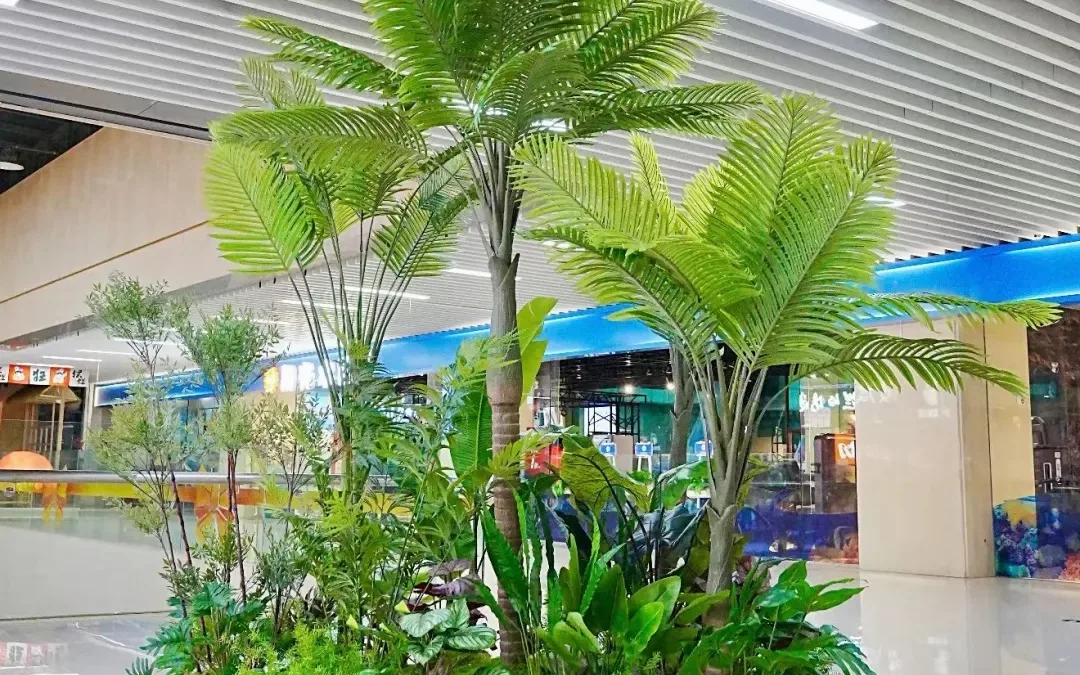
1. Failure Modes & Commercial Pitfalls
Areca clumps fail in lobbies for reasons that have nothing to do with how the fronds look in a sample photo. Five patterns account for most of the callbacks.
Colour drift behind glazing. A floor-to-ceiling curtain wall passes roughly 60–75% of incident UV depending on the coating, and a hotel atrium in Dubai or Riyadh takes 2,800–3,200 hours of direct sun a year. Unstabilised polyethylene shifts 6–9 ΔE in eighteen months, which reads as a uniform olive-yellow cast across every frond. Nobody notices it in month three; everybody notices it in month eighteen, and by then it is a replacement order rather than a complaint.
Clump collapse under its own canopy. Areca is sold as a multi-stem clump, and cheap clumps are five or seven separate stems pushed into one pot with no common structure. Each stem carries 4–6 kg of foliage at 5 m. Without a welded base ring, the stems splay outward, the clump widens by 300–400 mm at the top, and the silhouette that was approved in the render disappears. In a double-height reception this reads as a plant that has given up.
Leaflet shedding at cleaning height. Housekeeping wipes fronds weekly in a busy lobby. Silk leaflets are stitched and lose 3–5% of their pinnae per year to abrasion; injection-moulded leaflets on a moulded rachis do not detach, because there is no thread to break. The difference shows as bare patches at 1.6–1.8 m, exactly at eye level.
Undersized ballast. A 6 m clump with a 2.4 m canopy presents roughly 3.1 m² of sail area. A 90 kg planter is stable in still air and tips when a cleaning trolley or a luggage cart clips the rim. Base plates and ballast collars are covered in Section 5, but the failure is decided at quotation stage, when the planter is chosen for its finish rather than its mass.
Batch-to-batch dye drift on phased deliveries. A tower handed over in three phases takes three deliveries, often eight to fourteen months apart. Two production runs of the same colour code differ by 2–4 ΔE, which is invisible on a single plant and obvious across a row of nine. Lobbies are read as a composition, so the drift is read as inconsistency.
2. Material Science & Structural Engineering Standards
The artificial areca palm that survives a decade indoors is built around a welded steel spine, and everything above the pot is hung off that spine.
Core and clump structure. Q235 galvanised steel tube, 2.0–3.0 mm wall, is the working standard. A single-stem areca at 4.5 m needs 76 mm; a five-stem clump at 6 m needs 89–114 mm because the load path is eccentric — each stem leans, and the base ring has to resolve five moment arms rather than one. Clumps are made as one welded assembly: stems welded to a 6–8 mm base ring, the ring bolted to the planter's internal frame, never foam-packed. Foam-packed clumps pass a showroom inspection and fail a wind-tunnel or a trolley strike.
Trunk and crownshaft. Areca has a distinctive green crownshaft below the fronds, and it is where cheap product gives itself away. Centrifugal fibreglass moulded from a real trunk holds ring spacing to ±1.5 mm and keeps the colour break between shaft and trunk. Foam-wrapped trunks read as a painted cylinder at 1 m viewing distance, which is the distance a reception desk sits at.
Foliage compound. Injection-moulded polyethylene leaflets on a moulded polypropylene rachis, 0.9–1.4 mm thick, are the durable option. Silk is softer to the touch and photographs well, but it holds dust in the weave, and in a sealed lobby the dust load is the maintenance cost. Leaflet density is the spec that separates a full canopy from a sparse one: 1,900–2,600 leaflets per cubic metre of canopy volume for areca, counted on a 500 mm cube sampled at mid-canopy.
UV package. Stabilisation is a masterbatch question, not a coating question. A UV50+ compound carries hindered amine light stabilisers at 0.3–0.6% plus a UV absorber, and the supplier should be able to show an ASTM D4329 or ISO 4892-3 report at 1,000 hours with ΔE ≤3 and yellowing index ≤5. Lacquered "UV coating" on an unstabilised compound tests well initially and fails at 400–600 hours, which is why the test duration matters as much as the number.

3. Life Safety, Fire Codes & Environmental Compliance
Areca clumps in a lobby are interior finish material in the eyes of most authorities, and that classification brings tests that have nothing to do with horticulture.
North America. NFPA 701 is the reference test for textile and film-based decorative foliage. Method 1 applies to materials under 700 g/m² and measures char length after a 45° ignition; Method 2 applies to heavier assemblies and adds a weight-loss limit. A clump is a mixed assembly — moulded leaflets, polypropylene rachis, fibreglass shaft — so the report should cover the foliage component and state the test method and specimen mass.
Europe and GCC tender packages. EN 13501-1 Class B-s1, d0 is the usual entry ticket for a hotel or a Grade A office fit-out. The s1 sub-class limits smoke production in the first ten minutes, which is the parameter that decides whether a lobby can be evacuated without losing visibility. In the UAE the UAE Fire and Life Safety Code is enforced by Civil Defence, and a submittal that lists "fire retardant" without a test report and a specimen mass is normally returned.
Indoor air quality. A sealed lobby recirculates 85–95% of its air. Plasticiser and residual monomer migration from a poorly cured compound shows up as the "new plastic" smell that facility teams get complaints about in the first month. Low-VOC compounds with a 72-hour post-cure and a declared emission test avoid that conversation, and they matter more in lobbies with no operable windows than in any other space on the project.
Where the codes do not help. Fire ratings say nothing about whether a clump will still be standing after a decade of HVAC cycling. Treat the certificate as a gate, not a specification.
4. Technical Comparison Table
| Tree Height (m) | Min Core Steel Ø (mm) | Leaf Density (leaves/m³) | Floor Live Load & Ballast (kg) | Application | Indoor/Outdoor |
|---|---|---|---|---|---|
| 3.0–3.5 | 60 | 1,900–2,100 | 45–70 | Corporate HQ reception desk backdrop | Indoor |
| 4.0–4.5 | 76 | 2,000–2,300 | 90–140 | 5-star hotel atrium, planted island | Indoor |
| 5.0–5.5 | 89 | 2,200–2,500 | 160–240 | Mall atrium, escalator void edge | Indoor |
| 6.0–6.5 | 114 | 2,300–2,600 | 260–380 | Airport VIP lounge, double-height void | Indoor |
| 6.5–7.0 | 114 + base ring | 2,400–2,600 | 320–420 | Seaside resort lobby, glazed façade line | Indoor, UV50+ required |
Canopy diameter runs 0.42–0.48 × height for areca, so a 6 m clump presents 2.5–2.9 m across. Ballast figures assume a 1.5 safety factor against a 40 kg lateral nudge at 1.2 m, the load a luggage cart or a floor scrubber actually delivers.
5. Structural Anchoring & MEP Coordination
Two fixing methods cover almost every lobby, and the choice is made by the floor build-up, not by preference.
Chemical-anchored base plate. A 300 × 300 × 10 mm plate with four M12 chemical anchors at 120 mm embedment into a 200 mm slab resists 6–8 kN of uplift, which covers a 7 m clump at 38 m/s basic wind speed where the lobby opens to a terrace. The plate sits in a 40 mm recess and the finish is laid over it, so the fixing is invisible and the clump is removable for floor polishing. On post-tensioned slabs the anchor positions must be scanned first; drilling a tendon is a structural repair, not a snag.
Ballast collar planter. Where the slab cannot be drilled — raised access floors, waterproofed podiums, tenanted floors with reinstatement clauses — mass replaces fixing. The planter needs 260–420 kg of washed gravel or a steel counterweight ring at the base, and the clump's own base ring bolts to the planter frame so the two move as one body. A ballast planter without an internal frame is a heavy pot with a plant leaning in it.
MEP coordination. Three clearances decide whether the clump can stand where the designer drew it. Sprinkler heads need 450 mm of clearance below the deflector, so a 6.5 m clump in a 7.2 m void has to be offset from the branch line rather than centred under it. High-velocity air curtains at entrance doors deliver 12–18 m/s at the nozzle; a clump standing in that jet loses 15–20% of its leaflet life per year to flutter fatigue, and the fix is a 1.5 m setback, not a stronger stem. Where the lobby has a smoke exhaust strategy based on displacement, the clump counts as an obstruction and its plan position must appear on the fire strategy drawing.
Any departure from the standard base detail — a cantilevered plinth, a planter bridging a structural joint, a clump fixed to a glass balustrade upstand — needs engineering calculations issued as a stamped submittal, not a site decision.
6. Commercial Contractor FAQs
Q: What proof of UV performance should be requested before approving a lobby areca clump?
A test report to ASTM D4329 or ISO 4892-3 at 1,000 hours minimum, quoting ΔE and yellowing index, with the specimen identified as the same compound used in production. A 200-hour report proves nothing about a GCC lobby; 400–600 hours is where a lacquer coating fails and a stabilised compound is still passing.
Q: What is a realistic MOQ for a phased tower with nine identical clumps per phase?
Nine to twelve clumps per phase is a normal production batch, and the batch should be dyed in one run even if delivery is split. Where the phases are more than twelve months apart, order the full quantity in one production run and store the later phases crated — the storage cost is smaller than a colour mismatch across a lobby.
Q: How long from approval to a crated clump on site?
Four to six weeks for a standard 5–6 m areca clump, seven to nine weeks where the clump is bespoke or the planter is a custom fibreglass mould. Add two to three weeks of sea freight to a GCC port and one week for customs and inland delivery. A submittal approved in week one lands on site in week nine at the earliest.
Q: Can a faded clump be re-coloured on site instead of replaced?
Spot re-colouring works on a single frond and fails on a canopy. Aerosol tint sits on the leaflet surface, wears at the touch points within a season, and produces a patchy result under lobby downlights. Where ΔE has passed 5 across the clump, replacement is the only outcome that reads as uniform.
Project Engineering Support & CAD Requests
We issue shop drawings for lobby clumps as a package: plan position with sprinkler and air-curtain clearances, base plate or ballast collar detail, planter frame connection, and a finish swatch set matched to the approved dye lot. If a project is at submittal stage, send the lobby plan and the ceiling height and we will return the clump schedule with core diameters and ballast masses marked on it.
👉 Chat with Structural Engineering on WhatsApp (Instant Project Review)