Over ten years, one 5 m atrium position costs roughly three to six times more to keep alive than to keep artificial, and almost none of that gap is the purchase price. The gap is replacement events: three to six living specimens at 60–120% of an artificial tree's first cost each, plus the rigging and closure around every swap. The purchase order is the smallest number in the comparison.
Key Takeaways
- One 5 m atrium position over a decade: 3–6 living specimens replaced at 100–140% of a first installation each, versus zero replacement events before year 8–10 on the artificial side.
- Light decides the cadence: under glazing, most interior species receive 300–800 lux for part of the day, defoliate over 9–18 months and get swapped at 18–36 months; below roughly 500 lux for most of the working day, a living canopy of 4 m or more thins regardless of care.
- Care lines: 40–90 horticultural visits of 1.5–3.0 h each versus 20–30 artificial cleaning visits of 3–5 h, plus one partial re-dress at year 5–7 costing 30–45% of the original tree value.
- Water and energy: a 5 m specimen transpires 20–60 litres a week and needs grow lighting at 150–300 W for 8–12 hours a day; one leak event on polished stone exceeds the annual care contract.
- End of life belongs in the model: a dead specimen leaves as green waste plus a craned rootball; an artificial tree leaves as 6–12 m³ of bulky waste dismantled over 4–8 hours, sometimes charged as construction and demolition waste.
Where the Comparison Goes Wrong
The comparison fails the same way on almost every project: it is run at the wrong moment, by the wrong person, on the wrong number. Procurement compares purchase prices before the space opens, facilities inherits whatever was bought, and nobody compares what the two options cost to keep standing — so the decision is made on a figure that represents about a fifth of the real money.
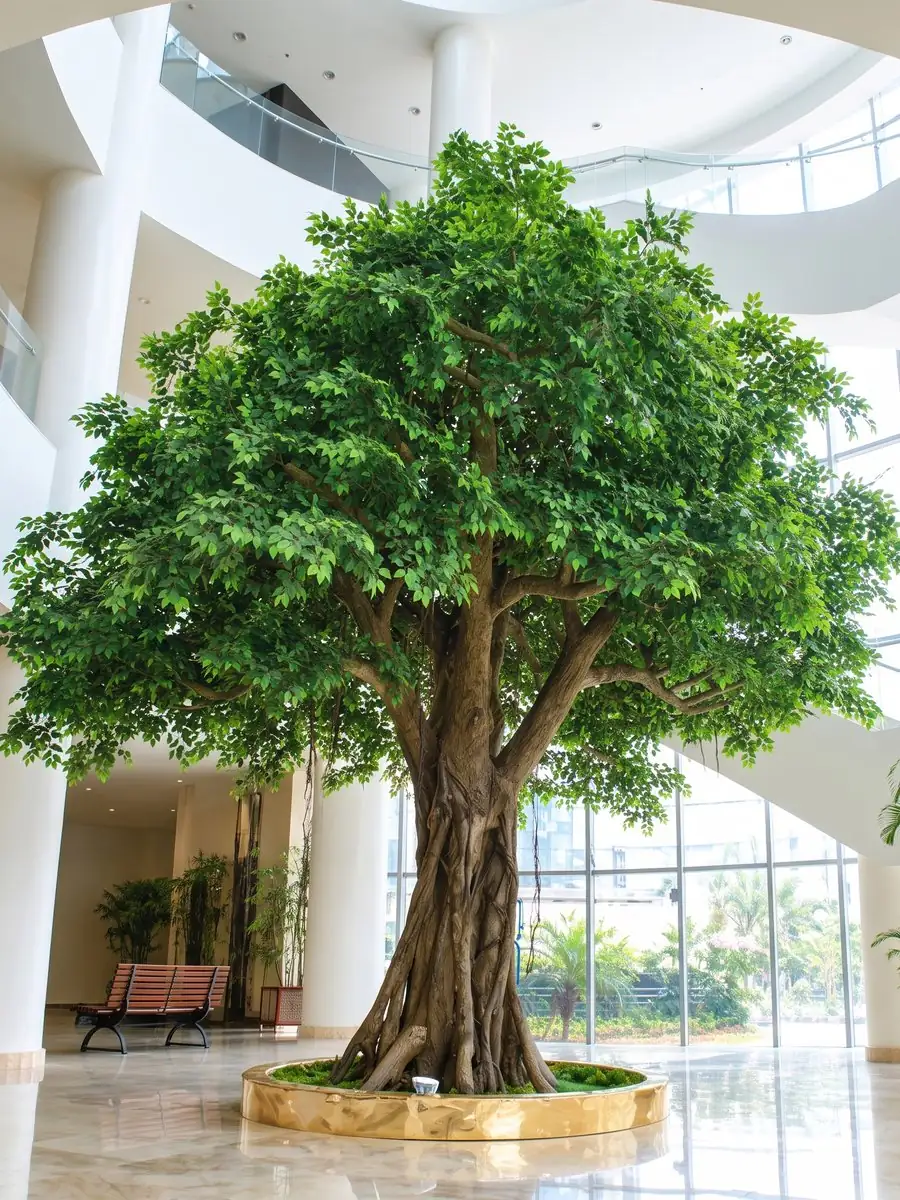
The purchase price is treated as the whole cost. A living 5 m specimen arrives with a rootball weighing several hundred kilos, needs a crane or rigging crew, a drainage tray built into the slab, irrigation and a horticultural contract from the first week. An artificial tree arrives crated and is set on a base plate. The first invoices can look comparable; the ten-year totals do not, because one of them keeps buying the tree again.
Replacement cadence is guessed instead of measured. Under glazing in a climate-controlled atrium, the usual outcome is defoliation over 9–18 months, a remedial attempt, then a swap at 18–36 months — three to six specimens for one position over a decade, each carrying plant cost, rigging, floor protection and at least a day of hoarding in the building's front door.
Water is treated as free and harmless. A 5 m specimen in a warm atrium transpires 20–60 litres a week, all of which has to go somewhere. Where the planter has no positive drainage, the tray is emptied by hand or the water finds the slab; on polished stone, one leak event costs more than the annual care contract, and the stain sits in the most photographed square metre of the building.
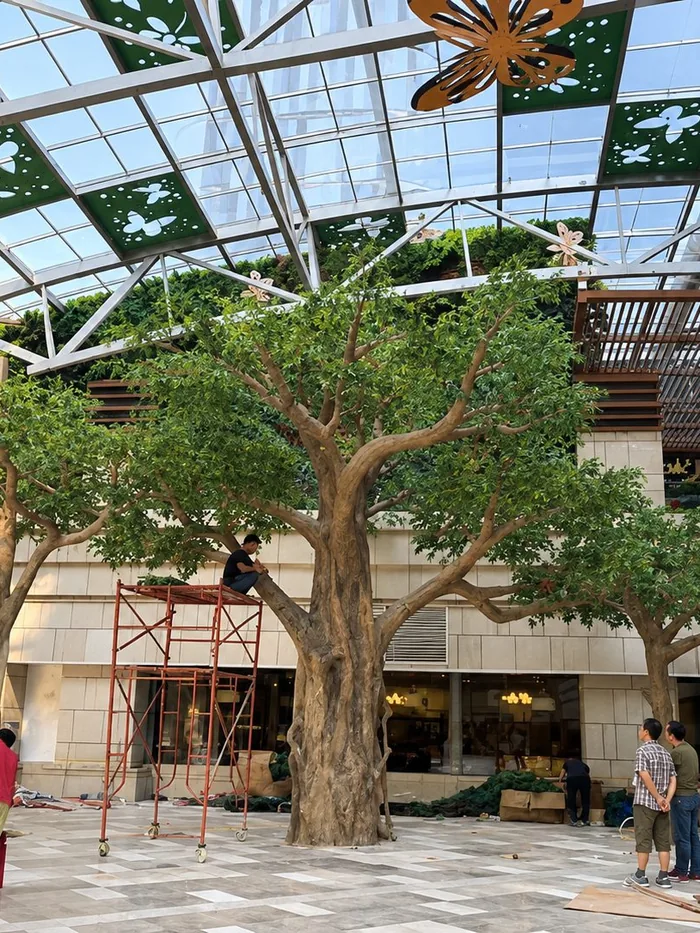
Artificial is assumed to cost nothing after handover. It costs cleaning and re-dressing. A canopy above 4 m needs a lift or a pole system at 3–5 crew-hours per visit, matte topcoat wears at the most-touched leaves, and the first partial re-dress lands at year five to seven at 30–45% of the original tree value. Projects that never budgeted it read the number as a failure rather than as scheduled maintenance.
Disposal is left out of both columns. A dead 5 m specimen leaves as green waste plus a rootball craned out through the same route it came in; an artificial tree at end of life is 6–12 m³ of bulky waste dismantled over 4–8 hours. Neither line is large, but both are the kind that turns a signed-off budget into a variation.
Six Tests That Settle the Position
Run the tests in order and stop at the first one that settles the question; most atrium positions are decided by the second.
Test 1 — Light. Measure horizontal illuminance at canopy height at 10:00, 13:00 and 16:00 on a clear day, and again in midwinter. Below roughly 500 lux for most of the working day, a living canopy of 4 m or more will thin regardless of care. Skylights do not fix this on their own: a deep atrium floor receives a small fraction of the roof illuminance, steeper at the edges than the centre.
Test 2 — Replacement cadence. Ask the horticultural contractor for the actual replacement rate on comparable sites, in specimens per position per decade, not in adjectives. Two or more replacements per decade means the living option carries a recurring capital line that usually outweighs every operating saving.
Test 3 — Access for both options. Identify what reaches the canopy — scissor lift, boom, mobile scaffold, or nothing. A 6 m canopy needs a lift for pruning, cleaning and any swap, and the route has to exist at 07:00 on a Sunday without closing the lobby. Hard access makes the living option difficult every 18–36 months; the artificial option needs it twice a year at most.
Test 4 — Floor and water. Check for positive drainage in the planter and a tray volume matching a week of transpiration. No drainage plus polished stone plus a high-traffic entrance ends in a repair invoice the care contract does not cover.
Test 5 — Appearance standard. Write down what "acceptable in year eight" means. If it is a specific colour and density at a specific distance, the artificial option needs a re-dress allowance and the living option needs a replacement allowance. A standard written as "healthy and green" cannot be inspected and both options will disappoint against it.
Test 6 — End-of-life route. Confirm how each option leaves the building: door width, lift capacity, crane position, waste classification. A position that can only be filled by crane can only be emptied by crane, and that fact belongs in the ten-year model.
The output is a one-page record: lux readings, replacement rate, access method, drainage status, appearance standard, removal route. That page is what a facilities budget should be built from, and it is what settles the argument when a later manager asks why the atrium has artificial trees in it.
Running the Model Across the Project Timeline
At brief. Ask for the position to be described in operating terms: height, canopy diameter, hours of daylight, access method, floor finish, and who will care for it. A brief that says "large feature tree, natural look" has already deferred every decision that determines the ten-year cost.
At concept design. Run the six tests and record the result. Where the answer is mixed — a bright atrium that could carry a living canopy at ground level but not at mezzanine level — split the position rather than forcing one answer across the space. A mixed scheme is usually the cheaper scheme, because each option is used where its cost structure fits.
At specification. For a living canopy, specify the drainage, tray volume and irrigation, and put the replacement allowance in the budget as a line rather than a contingency. For an artificial one, specify the cleaning interval, the access method and the first re-dress year. Both specifications are one page, and neither exists on most projects.
At handover. Hand over the one-page record, a photograph set and the maintenance schedule. Facilities that inherit the drawing, the cleaning method and the re-dress year will run the position; facilities that inherit a WhatsApp message will not.
At the year-three and year-five reviews. Compare actual against model: visits, hours, replacements, drift at the witness points. The next position in the same building gets specified from those numbers rather than from a supplier's brochure.
The commercial atrium case is where this discipline pays best, because the position is large, visible and expensive to change. On a scheme with several atria the model can be run once per position type and reused, which is why the first one is worth doing properly rather than by eye.
The Ten-Year Cost Table
| Cost line | Living specimen, ten years | Artificial tree, ten years | What drives the number |
|---|---|---|---|
| First cost, delivered and set | 60–120% of the artificial alternative, including rigging | 1.0× baseline | Rootball weight, crane or rigging, floor protection, drainage build |
| Replacement events | 3–6 specimens, each 100–140% of a first installation | 0 events before year 8–10 | Light level, species, HVAC airflow, irrigation reliability |
| Routine care contract | 40–90 visits, 1.5–3.0 hours each | 0 | Weekly or fortnightly visits, plus emergency call-outs after events |
| Cleaning and re-dress | Not applicable | 20–30 visits at 3–5 hours; one partial re-dress at 30–45% of tree value | Canopy height, access method, dust load at the entrance line |
| Water, drainage and energy | 20–60 litres a week plus grow lighting at 150–300 W for 8–12 hours a day | 0 | Whether the position can be kept alive without supplementary light |
| Removal and disposal | Green waste plus rootball, craned out, 1 day of closure per event | Bulky waste, 6–12 m³, 4–8 hours of dismantling | Door width, lift capacity, waste classification |
| Closure days in a revenue space | 1–2 days per replacement, 4–10 days over ten years | 0.5 day per re-dress, 2–3 days over ten years | Hoarding, access route, event calendar |
Read the replacement row against the first-cost row and the ranking becomes obvious: the living option's first cost is often lower than the artificial one, and its second cost is a multiple of it. A 5 m specimen bought at 80% of the artificial price and replaced four times over a decade has spent 4.2 times the artificial first cost before any care contract is counted.
The tiers matter more than the averages. A 2.5–3.5 m position in a bright, single-height space with a door wide enough to walk a specimen through can be run on a living canopy and often is; a 6–8 m position under glazing with crane-only access usually cannot, and the reason is arithmetic rather than taste — each swap costs a crane, a night shift and a closure, and there are three to six of them in the decade.
One number belongs in the brief even when the answer is artificial: the appearance horizon. Interior foliage cleaned on schedule holds a colour drift of roughly ΔE ≤ 3 for about five years, then drifts faster at the upper leaf faces. Planning the first re-dress at year five, rather than discovering it at year eight, is the difference between a maintenance line and a replacement decision.
FAQ
Which option is cheaper over ten years for a 5 m atrium tree?
The artificial one, usually by a factor of three to six, and the gap is created by replacement events rather than the purchase price. A living specimen under glazing typically needs three to six replacements in a decade at 100–140% of a first installation each. Where the position receives strong daylight and can be reached without a crane, the gap narrows but rarely closes.
Does an artificial tree really need a maintenance budget?
Yes: 20–30 visits over ten years at 3–5 hours, plus one partial re-dress at year five to seven costing 30–45% of the original tree value. Budgeting zero is the most common mistake in the artificial column, and it is what makes the first re-dress invoice look like a defect claim.
How do I estimate the replacement rate before I have any history?
Ask the care contractor for specimens replaced per position per decade on comparable sites, then adjust for light and access. A position below 500 lux for most of the day, in a warm atrium with strong air movement, sits at the upper end of the range; a bright, single-height lobby with good access sits at the lower end.
When does a living tree actually make sense in a commercial atrium?
When the position receives real daylight, has positive drainage, sits within reach of a lift, and the building has a care contract that already covers the zone. In that case a living canopy is a genuine option and often the better one visually. The four conditions are what to test; the species is a detail that comes after.
References and Authoritative Sources
The ten-year model in this article is built from project cost records rather than laboratory standards. The one external measurement referenced — the colour-drift acceptance figure of ΔE ≤ 3 used to define the artificial tree's appearance horizon — corresponds to colour-difference calculation practice described in the following standard:
Standard Practice for Calculation of Color Tolerances and Color Differences from Instrumentally Measured Color Coordinates
>
— ASTM International, ASTM D2244. ASTM International standards
Project Engineering Support
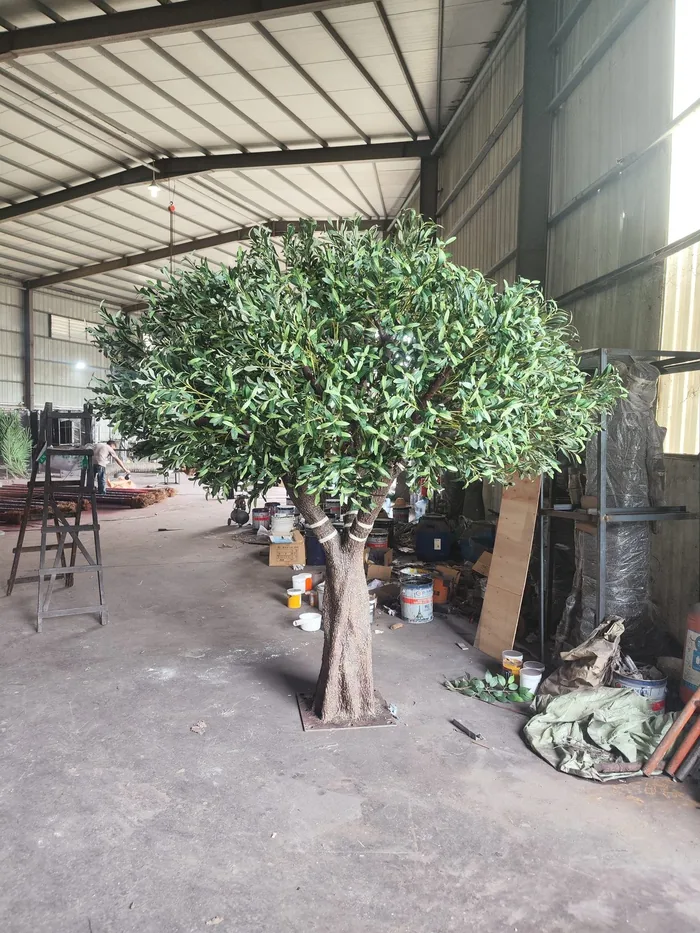
We build the artificial side of this comparison, so the honest version of our position is that the model decides and the product follows. Send the position dimensions, the access method and the appearance standard, and we return the build that fits, the cleaning interval, the re-dress year and the removal route in the same one-page format the cost model uses — on a hotel atrium position the re-dress year and the access plan are the two numbers most often missed at handover. A 5 m olive tree in a bright lobby is a good example: the same position can carry either option, and the ten-year numbers are what separate them.
👉 Chat with Structural Engineering on WhatsApp (Instant Project Review)