Executive Summary
Artificial greenery for commercial projects is a different procurement problem from a single feature tree. A lobby programme may combine forty to two hundred potted units across five to fifteen species — heights from 0.8 to 3.5 m, stem cores of Ø12–30 mm galvanized steel, planter ballast between 15 and 70 kg per unit — and fire-rated foliage that must arrive certified to NFPA 701 or EN 13501-1 Class B-s1,d0. Holding those numbers across a mixed order is only realistic when the buyer audits the factory that moulds the foliage, not the office that quotes it.
1. Failure Modes & Commercial Pitfalls
The most expensive failure in greenery sourcing is not material — it is identity. A trading office quotes a mixed programme low, sub-contracts across whichever workshops have open capacity, and the substitution surfaces only when the container opens: pot glazes in three slightly different shades of the "same white", leaf tones that drift between species bought from different sources, trunk textures that belong to two different product generations. On a single feature tree a buyer can inspect one asset before shipment. On a two-hundred-unit greenery programme, every one of those inconsistencies ships inside the same cartons, and re-making even ten percent of the order costs four to six weeks plus a second freight slot.
Cheap material alternatives fail in predictable physical ways. Polyester silk foliage under 24/7 lobby lighting fades within twelve to eighteen months in the brightest zones and holds dust in every fold, which turns a once-convincing plant visibly grey at the edges. Surface-sprayed fire retardant abrades during carton handling and cleaning, so the treatment that passed the sample fails the site inspection. Blow-moulded nursery pots crack under the 15–70 kg ballast that commercial installations actually apply, and foam "soil" tops collapse the first time a cleaner lifts the plant.
Mixed-species programmes add a third failure layer: consistency. Two workshops moulding the same bird-of-paradise leaf will not match pigment or vein depth, and the difference reads immediately when the units stand in one row. Facility managers installing against a hotel atrium specification or a mall tender discover at handover that acceptance committees compare units side by side — variation that a catalogue photo would hide becomes a punch-list item. The fix is procedural, not visual: single-source the programme, and verify who owns the moulds.
The audit itself is cheap against that failure mode. One to two days on site covers everything a greenery programme depends on: the injection hall (machine count and clamp tonnage say whether the foliage volumes quoted can actually be produced in one colour window), the pigment kitchen (where species-level colour recipes are weighed and batch-logged), the mould register (a workshop that owns its bird-of-paradise and monstera moulds can re-run a lot three years later; a workshop that rents capacity cannot), and the packing bay on the day of the visit — whether units leave in individual cartons with foliage sleeved or are stacked bare into master boxes. An office that cannot walk a buyer through those four stations within a week of being asked is reselling.
2. Material Science & Structural Engineering Standards
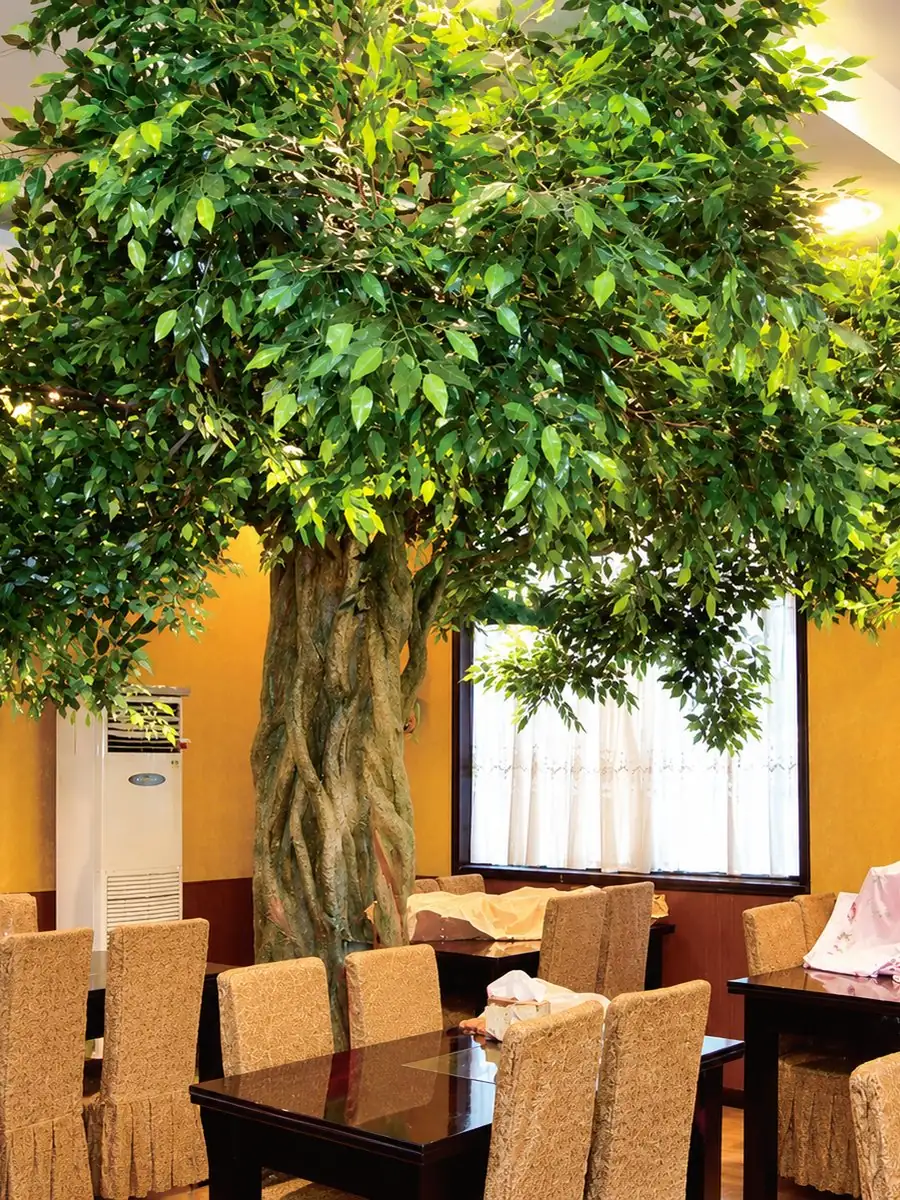
Foliage decides both realism and fire behaviour. Injection-moulded polyethylene (PE) leaves carry vein relief, matte multi-tone pigmentation and controlled translucency; dense specimen builds run 1,800–3,200 leaves per cubic metre of canopy volume. Silk or polyester alternatives print their pattern on flat fabric, shine under spotlights and crease permanently after carton compression. For any species placed near glass or under atrium glazing, UV-stabilised PE is the only formulation that holds colour; standard indoor pigment yellows within one to two summers even behind glass.
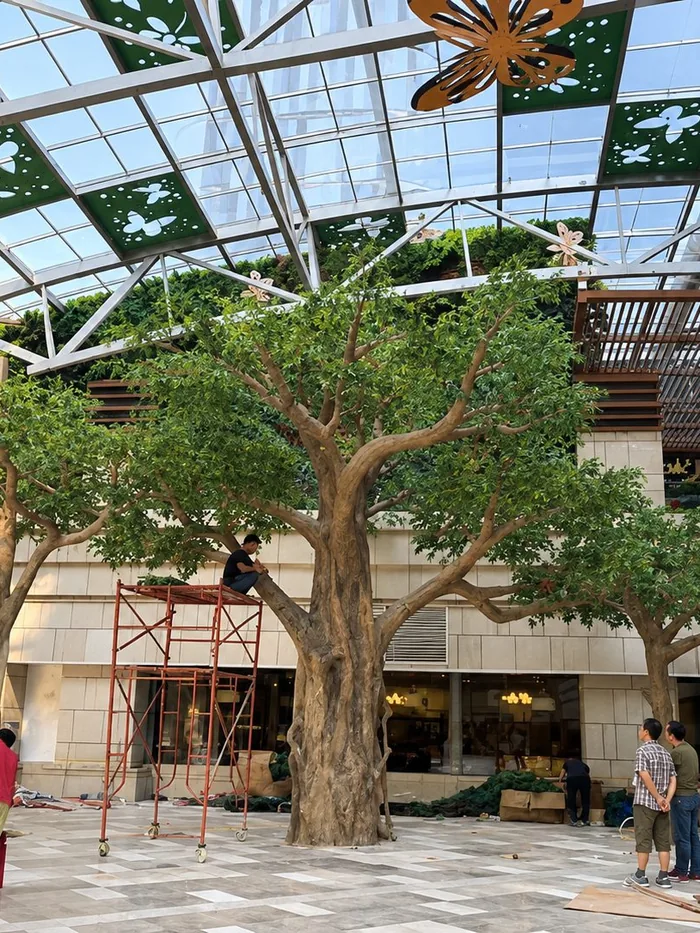
Structural cores follow height. Potted species up to roughly 1.2 m — ferns, calatheas, small specimen grasses — build on steel-wire stems anchored into a poured foam-and-cement root base. Tall upright species (bird of paradise, dracaena, areca clumps above 1.5 m) need galvanized steel stem cores of Ø12–25 mm welded or bolted to a base plate, because canopy leverage at 2 m multiplies every gram of top-heavy foliage into stem flex. Trunk-built species use a Q235 steel skeleton over centrifugally-cast fiberglass bark, which resists the creep and delamination that foam trunks show within two years.
Colour control across a mixed order is a manufacturing discipline, and it is auditable. A factory running species-level colour recipes keeps a golden sample per SKU, logs pigment batches by weight, and schedules every unit of one species inside the same colour window — which is why a single-species re-order placed months later still asks for the batch reference, not just the SKU code. Buyers can test this without visiting: request two production photos of the same species taken six months apart and compare leaf tone. Drift between those photos predicts exactly what a two-hundred-unit programme split across two workshops would look like.
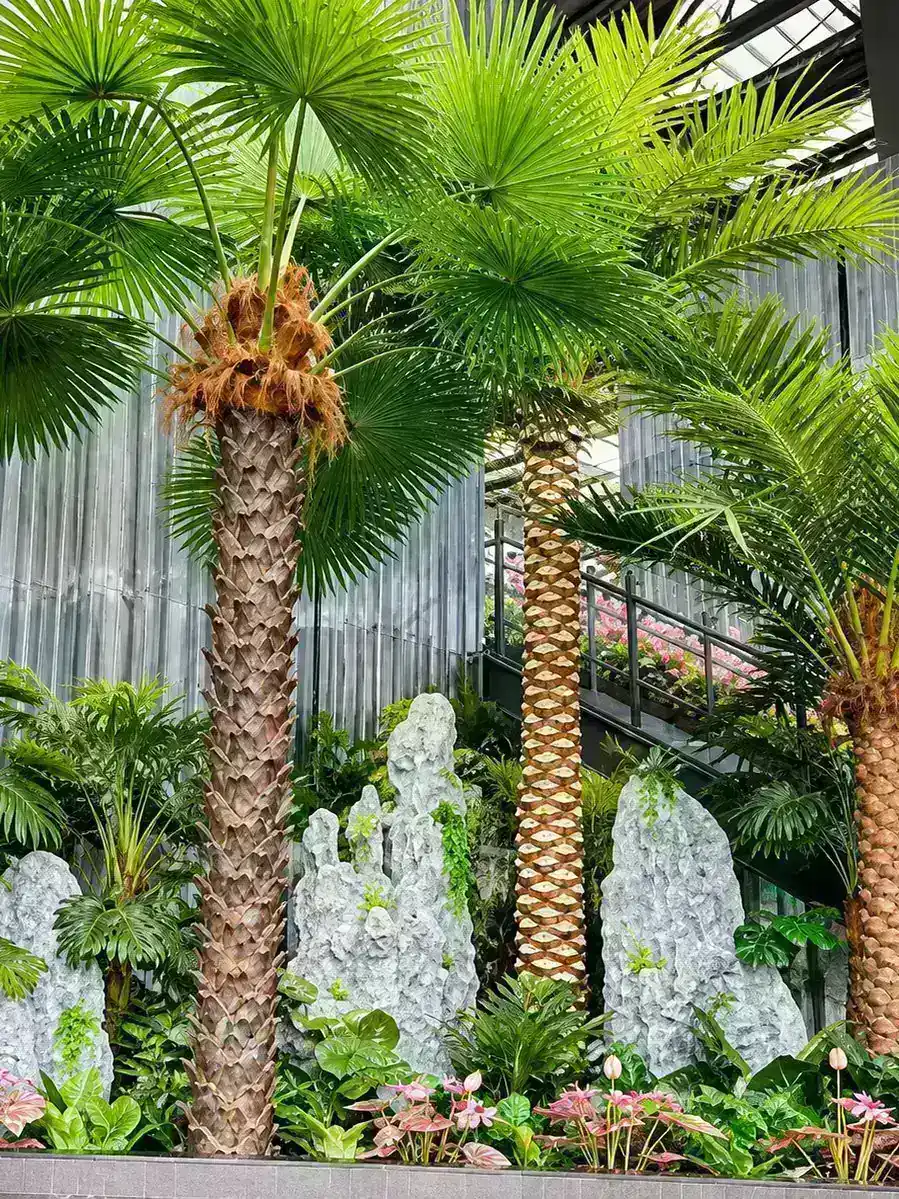
Planters are part of the structure, not packaging. Commercial-grade fibreglass planters run 3–4 mm walls with an integrated ballast compartment; thin blow-moulded pots flex under load and transfer wobble to the stem core, which reads as a cheap installation even when the foliage is excellent. Species selection matters as much as material: programmes typically anchor on broad-leaf statement plants — monstera, bird of paradise, fan palm — supported by finer textures, and Mediterranean palettes still lean on the olive tree for its muted grey-green tone, which survives changes in brand colour schemes better than most tropical greens.
3. Life Safety, Fire Codes & Environmental Compliance
Fire documentation is where trader-sourced greenery most often fails acceptance. North American projects reference NFPA 701, which separates Method 1 (lightweight fabrics under 700 g/m²) from Method 2 (heavier materials); European and GCC tenders reference EN 13501-1, where Class B-s1,d0 is the common contractual line for decorative foliage in escape routes and lobbies. The engineering distinction that matters is inherent vs post-treatment: inherently fire-retardant (IFR) polymer carries the retardant in the compound, so it survives abrasion and cleaning, while sprayed retardant sits on the surface and wears off exactly where inspectors rub — leaf edges and pot rims.
Compliance evidence should be document-level, not certificate-level. A batch traceable report names the material compound, the test method and the lab; a generic "fire certificate" PDF that lists thirty unrelated products proves nothing about the foliage in the container. For closed HVAC environments — airport lounges, hotel rooms, corporate reception areas — specify low-VOC, odour-free polymer grades and ask for the material safety documentation alongside the fire report. Suppliers serving GCC civil-defence authorities and EU projects should be able to state, per product line, whether a given certification ships with the model or is quoted per project order; the honest answer varies by species, and a supplier who claims every SKU carries every certificate is usually reselling.
4. Technical Comparison Table
| Tree Height (m) | Min Core Steel Ø (mm) | Leaf Density (leaves/m³) | Floor Live Load & Ballast (kg) | Application | Indoor/Outdoor |
|---|---|---|---|---|---|
| 0.9 | 12 | 1,800 | 15–20 | corporate HQ reception desk groups | Indoor |
| 1.5 | 16 | 2,200 | 20–30 | 5-star hotel corridor alcoves | Indoor |
| 2.1 | 20 | 2,600 | 30–40 | airport VIP lounge space dividers | Indoor |
| 2.8 | 25 | 3,000 | 40–55 | mall landscaping perimeter zones (UV-stabilised) | Outdoor |
| 3.5 | 30 | 3,200 | 55–70 | seaside resort entrance planting (salt-mist coating) | Outdoor |
Read the table as a procurement floor, not a catalogue. A 1.5 m unit specified for a hotel corridor needs the Ø16 mm core and the 20–30 kg ballast range simultaneously — a supplier who meets one number and quietly drops the other is the pattern audits exist to catch. Outdoor rows add UV stabilisation and, within coastal salt exposure, marine-grade coating on every exposed metal part.
5. Structural Anchoring & MEP Coordination
Free-standing potted units in low-traffic zones resolve stability through the ballast collar planter: 15–20 kg distributed low in the base is enough for foliage up to 1.2 m in still air. Above 2 m, or anywhere near door lines, the calculation changes — entrance air curtains run 8–12 m/s and turn a top-heavy 2.5 m specimen into a lever. Programme specifications for those positions move to mechanical fixing: base plate with chemical anchors into the structural slab, torque-checked, with custom anchor details and the load path documented so the architect can countersign.
MEP coordination has two recurring traps. First, sprinkler interaction: decorative foliage must respect the clearance maintained below sprinkler deflectors — commonly applied at 460 mm — and dense canopies placed into the spray cone can block distribution enough to fail the hydrant commissioning walk-through. Second, cleaning access: units fixed against glass or uplighters need a documented service position, because a 40 kg ballasted planter that cannot be moved for quarterly cleaning ends up not being cleaned, and dust does more visible damage to realism than any UV fade. Reference installations at this coordination level are worth requesting — finished programme photos on the projects page show which suppliers actually ship fixed, serviceable installations rather than staged showroom shots.
A practical audit-day sequence ties the sections above together. Morning: injection hall and pigment kitchen, with the mould register checked against the species list in the buyer's own schedule. Midday: assembly lines for the specific programme SKUs — stem core fitting, pot-filling, ballast weights weighed on the line scale rather than claimed. Afternoon: fire documentation reviewed against batch records, then the packing bay while the actual production run is being cartoned. Photograph the golden samples of every species in the order and keep them as the shipment reference; units that arrive off-tone against those photographs are the factory's re-make, not the buyer's problem. A trader who survives the morning usually fails the afternoon — batch paperwork and live packing are the two stations that pass-through suppliers cannot stage.

6. Commercial Contractor FAQs
Q: How can a buyer confirm a greenery supplier is a factory rather than a trader?
A: Ask for three things the office cannot fake quickly: a mould register listing the foliage moulds for the exact species quoted, a workshop video call where the salesperson walks the injection and assembly lines (not a sample room), and the plant's business-scope registration matched against the products. Traders can arrange factory tours once; they cannot explain clamp tonnage, mould counters or pigment batching on the spot. For a mixed programme, ask which SKUs are moulded in-house and which are bought in — the honest split tells more than the brochure.
Q: What fire documentation should a mixed potted-greenery order include?
A: Batch-referenced test reports per foliage compound (NFPA 701 Method 1 or 2 as the specification requires, or EN 13501-1 Class B-s1,d0 for EU/GCC tenders), the material safety sheet for the polymer grades, and a written statement of whether the retardancy is inherent or post-treated. Certificates listing unrelated product families should be rejected at document review.
Q: What MOQ applies to a multi-species greenery programme?
A: Project-based. Per-SKU minimums in a consolidated mixed programme are typically driven by pot size, pigment batching and carton fit — not a universal number. Confirm in writing that the quoted per-SKU quantity covers colour-matched batches from one production window, which is the actual constraint behind consistency.
Q: How does lead time differ between greenery programmes and single-species orders?
A: Standard heights run 25–35 days for production. Mixed programmes add roughly 5–10 days, almost all of it in pigment batching and staggered assembly of foliage lots so every unit in a species ships from the same colour window. Rushing that stage is how two-pot-shade shipments happen.
Project Engineering Support & CAD Requests
For mixed greenery programmes we work the same way as for structural trees: send the planting schedule and planter positions, and our engineering team returns a per-unit specification — stem core, ballast, fixing type, fire documentation set — with CAD details for any mechanically fixed positions. We can supply submittals, finish swatches for foliage and planters, and batch test reports before production starts. For a live tender or a programme under review, message the structural engineering desk on WhatsApp for an instant project check:
👉 Chat with Structural Engineering on WhatsApp (Instant Project Review)