How Long Do Outdoor Artificial Trees Last?
Outdoor service life is not a single number printed on a product page. It is the outcome of three site-specific decisions made before production: the foliage material and its UV package, the structural design against local wind exposure, and the fixing method at the base. A tree specified for a sheltered courtyard should not be ordered unchanged for an exposed coastal terrace.
Short answer
Outdoor artificial trees are engineered per site rather than rated with one universal lifespan. UV-stable foliage is used for exterior builds, trunk and branch frames are designed against site wind exposure, and the base is fixed or ballasted to suit the substrate. Facility teams should plan periodic foliage inspection, cleaning and replacement of individual fronds instead of replacing the whole tree.
What does UV-stable foliage mean in practice?
UV-stable foliage is manufactured with additives that slow colour fade and surface embrittlement under sunlight. It is a material choice for exterior builds, not a promise that colour never changes. Exposure differs enormously between a shaded hotel courtyard and a rooftop terrace at altitude, so the specification should record orientation, hours of direct sun and whether the tree sits behind glass. Where a project has a defined colour reference, agree a swatch approval before mass production so the delivered foliage can be checked against something physical.
- Record sun orientation, daily direct-sun hours and glazing conditions.
- Approve a physical foliage swatch before production for colour-critical projects.
- Expect gradual tonal change outdoors; plan for individual foliage replacement.
How do wind exposure and base fixing change the build?
A canopy is a sail. At 6 m and above, wind exposure drives the trunk core, the branch connections and the base detail, not just the silhouette. Exposed sites commonly use a steel base plate with mechanical anchors into concrete, or a ballasted planter whose weight is calculated against the canopy area. The submittal should state the assumed exposure, the anchorage pattern and who is responsible for the substrate check. A fire classification has no bearing on this calculation.
- State the site exposure category and the canopy area in the enquiry.
- Specify base plate, anchor pattern or ballast weight explicitly.
- Confirm who verifies the concrete or deck substrate on site.
Which species work best on exposed sites?
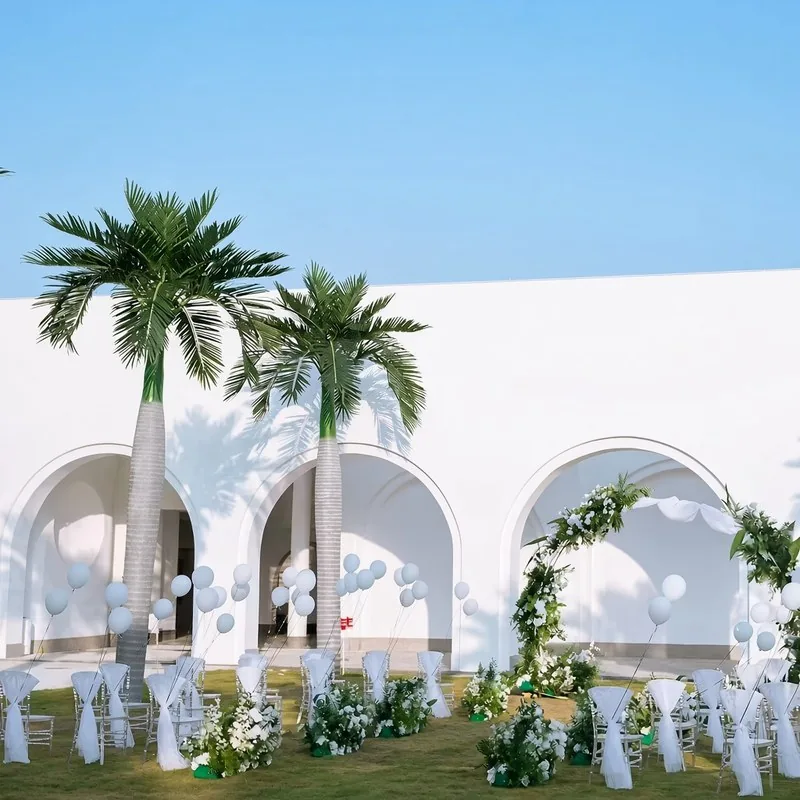
Species with open, divided foliage generally shed wind better than dense solid crowns. Date palm, king palm and fan palm are common choices for resort courtyards, pool decks and coastal restaurants because their fronds are individually replaceable. Olive and ficus can work well in sheltered terraces where the softer silhouette is wanted. For very large exposed sites, the engineering question is the frame and base rather than the species name, so the final selection is made together with the wind and fixing assessment.
- Open, divided fronds: date palm, king palm, fan palm for exposed terraces.
- Denser crowns: olive and ficus for sheltered courtyards.
- Above 6 m, decide from the frame and base calculation first.
What maintenance should a facility team plan?
Outdoor trees are low-maintenance but not maintenance-free. A sensible plan includes a visual inspection each season, periodic dust and salt removal with water, tightening of accessible fixings after the first storm season, and replacement of individual fronds or leaf sprays rather than the whole specimen. Ordering a small spare foliage pack with the original build keeps colour and finish consistent years later, which is much cheaper than re-producing a matched canopy.
- Seasonal visual inspection of canopy, trunk junction and base.
- Rinse dust and salt deposits; avoid abrasive cleaning on foliage.
- Order a matched spare foliage pack with the original production run.
How do coastal and high-altitude sites differ?
Coastal sites add salt-laden air and frequent gusting, so fastener material, drainage around the base and the finish on exposed steel deserve attention. High-altitude or high-irradiance sites add stronger ultraviolet exposure and larger day-night temperature swings, which affect foliage and coatings differently. Both cases are handled by specifying the build against the site rather than by adding a generic 'outdoor' checkbox to a catalog item; the enquiry should include location, exposure and substrate.
- Coastal: fastener material, base drainage, salt rinse schedule.
- High irradiance: foliage UV package and coating selection.
- Always send location, exposure description and substrate type.
| Site condition | Foliage decision | Structure decision | Maintenance focus |
|---|---|---|---|
| Sheltered courtyard | UV-stable foliage, swatch approval | Standard base, verified substrate | Seasonal rinse and inspection |
| Coastal terrace | UV-stable foliage, salt-tolerant finish | Anchored base plate, drainage detail | Salt rinse, fastener check |
| Rooftop / high exposure | Enhanced UV package | Engineered frame, ballast or anchors | Post-storm fixing check |
| Semi-outdoor under glass | Colour-critical swatch approval | Reduced wind case, still fixed | Glass-side cleaning access |
Frequently Asked Questions
How many years will an outdoor artificial tree keep its colour?
There is no single guaranteed figure: sunlight hours, orientation, altitude and salt exposure all change the rate of tonal shift. UV-stable foliage is used for exterior builds and a matched spare foliage pack can be ordered with the original production run.
Can an indoor tree be placed outside?
Not by changing the label. Outdoor builds are designed against site wind exposure, UV exposure and base fixing; an interior specification does not include that engineering.
What is needed to quote an outdoor project?
Location, sun orientation, exposure description, substrate type, planned fixing method and target height. Those inputs determine the foliage package, frame and base detail.
Quote an outdoor tree as an engineered assembly: site exposure, substrate, fixing method and foliage package belong in the enquiry. The species name comes after those four items, not before them.