How Do You Specify an Artificial Peach Tree?
Peach trees are ordered for a very specific visual job: a warm, fruit-bearing silhouette that reads as abundance from a distance and still holds up at close range. Getting that result is less about the species name and more about four numbers in the specification. This guide is written for hotel, retail and showroom buyers who need to turn a mood image into an order sheet.
Short answer
An artificial peach tree is specified by height, canopy spread, fruit count and branch structure, plus the planter or base finish. Commercial builds are commonly produced in the 1.5-4 m band for lobbies, restaurant terraces, retail displays and showroom sets. Fruit density should be stated as a count per crown, and a physical swatch should be approved for fruit colour before mass production.
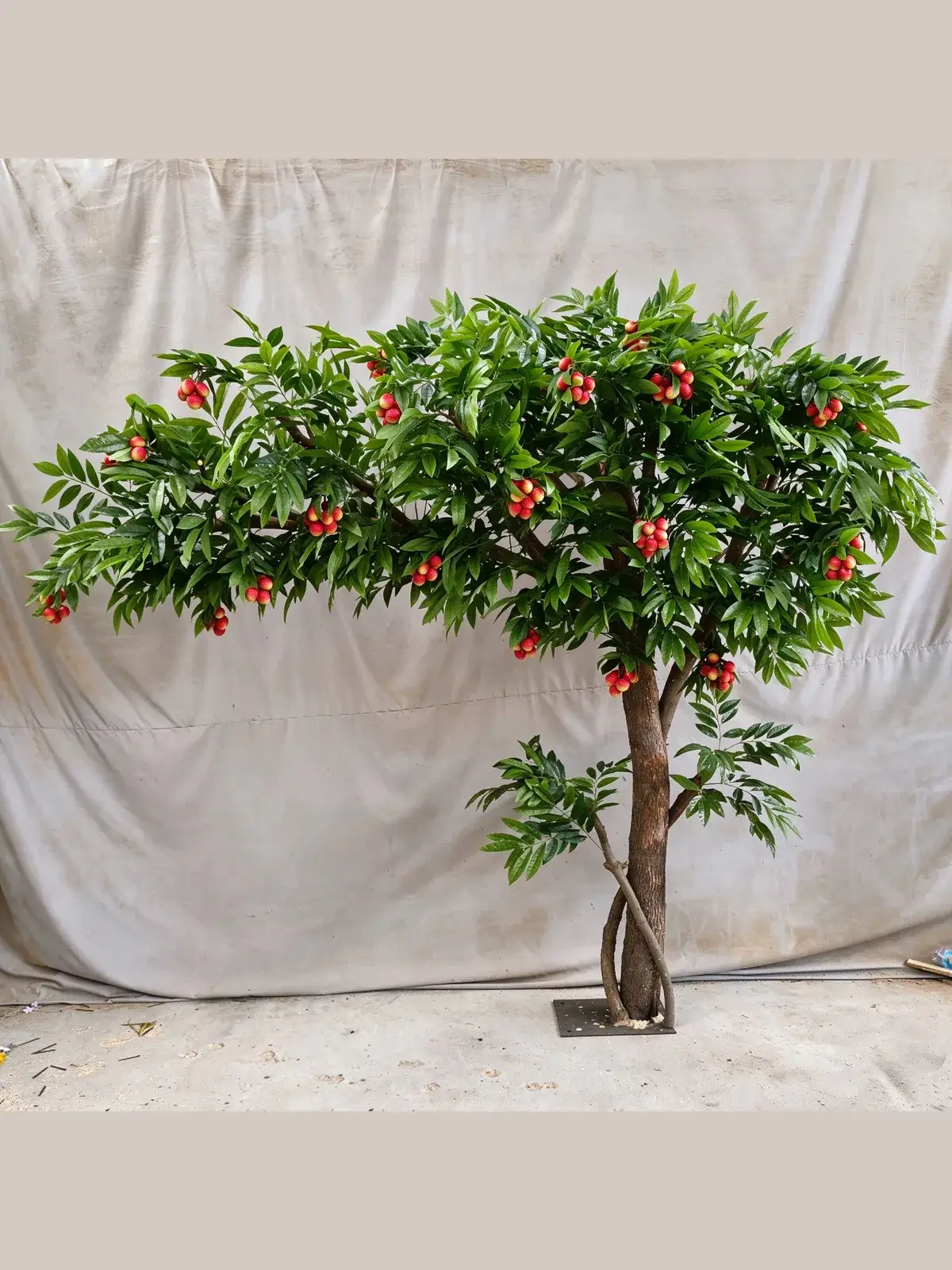
What makes an artificial peach tree convincing?
The eye catches three things first: the fruit-to-leaf ratio, the way branches droop under weight, and the bark transition at the first fork. Too many fruits read as decoration rather than a tree; too few read as an unfinished sample. Commercial builds normally distribute fruit in clusters with visible leaf gaps, and use a sculpted trunk with a gradual taper. Ask for a finished-tree photograph of the actual configuration, not a close-up of one branch, because close-ups hide the distribution that a visitor sees.
- Judge the whole crown in a finished-tree photograph, not a branch close-up.
- Specify fruit clusters with visible leaf gaps rather than uniform coverage.
- Check the first fork and trunk taper at eye level.
Which venues use artificial peach trees?
Peach builds appear most often where a seasonal or auspicious theme must stay in place all year: hotel Chinese restaurants, retail Spring Festival campaigns, banquet entrances, tea rooms and showroom photo sets. They are also used by tree shops and showrooms as a compact fruit-tree sample that customers can inspect at close range. Because the tree is a display object, the planter and the base finish matter as much as the canopy; a showroom sample may be ordered with a different planter from a banquet installation.
- Hotel restaurants, banquet entrances and tea rooms.
- Retail seasonal campaigns and window displays.
- Showroom samples for local tree shops and distributors.
How are fruit density and branch structure specified?
Write fruit density as a count per crown or per main branch, and state the approximate fruit diameter. That makes a repeat order reproducible and gives the factory a clear target for moulding and assembly. Branch structure should cover the number of main limbs, the first-branch height above the planter rim, and whether the crown is open or compact. Where the tree will be photographed from one side, mark the preferred facing so the densest clusters sit on that side of the build.
- Fruit count per crown plus approximate fruit diameter.
- Main limb count, first-branch height and crown openness.
- Preferred facing for one-sided photography or window sets.
What sizes and planter options are available?
Commercial peach builds are most often produced in the 1.5-4 m band, which covers lobby corners, restaurant terraces and retail displays while staying manageable for delivery. Larger custom fruit trees can be engineered with a knock-down trunk where the access route requires it. Planter choices range from a simple nursery pot hidden inside a decorative outer planter to a weighted base for high-traffic areas. Confirm the outer planter dimensions in the drawing, because they change the overall height that appears on the elevation.
- Common band 1.5-4 m; custom larger builds use knock-down sections.
- Weighted base recommended for high-traffic public areas.
- Outer planter height must be included in the overall elevation.
How does a peach tree differ from blossom or citrus builds?
Cherry blossom and white blossom builds are specified by flower density and petal tone, with no fruit to distribute; citrus and lemon builds use smaller, higher-count fruit with a different leaf shape; peach uses larger, warmer fruit with a softer blush. Mixing the vocabulary causes expensive revisions. If the project also needs other fruit species in the same container, list each SKU separately with its own fruit count so the packing sheet and the receiving check stay unambiguous.
- Blossom builds: flower density and petal tone, no fruit count.
- Citrus builds: smaller fruit, higher count, different leaf shape.
- List each fruit SKU separately on mixed orders.
| Build | Primary visual target | Key number to specify | Typical venue |
|---|---|---|---|
| Peach | Warm fruit, drooping branches | Fruit count per crown | Restaurant, retail, showroom |
| Cherry / white blossom | Flower mass and petal tone | Flower density | Hotel terrace, event set |
| Lemon / citrus | Small bright fruit, dense leaf | Fruit count and diameter | Retail, cafe, window display |
| Apple / mixed fruit | Full rounded crown | Crown spread and fruit mix | Showroom, banquet entrance |
Frequently Asked Questions
What height should I order for a hotel restaurant?
Most restaurant and lobby peach builds fall in the 1.5-4 m band. Choose from clear ceiling height and the intended viewing distance, then add the outer planter height to the overall elevation.
Can I order several fruit species in one container?
Yes. Mixed loading across SKUs is supported; list each fruit species with its own fruit count and diameter so the packing sheet stays unambiguous.
How do I keep a repeat order consistent?
Approve a physical fruit and foliage swatch on the first order, keep the fruit count per crown and the preferred facing in the specification, and reference the original SKU when reordering.
Turn the mood image into four numbers: height including planter, crown spread, fruit count per crown and first-branch height. Add a physical fruit swatch for colour, and a repeat order becomes straightforward.